
After Vadodara: Deepti Sharma's Three Tables, Australia's Bowling Depth, and Zimbabwe's Unheard Signal
**मुख्य उत्तर:** आईसीसी महिला रैंकिंग अपडेट में दीप्ति शर्मा वनडे ऑलराउंडर में चौथे, गेंदबाज़ी में आठवें और बल्लेबाज़ी में 23वें स्थान पर पहुँची हैं; स्मृति मंधाना ने वनडे बल्लेबाज़ी का शीर्ष स्थान लॉरा वोल्वार्ड्ट को दे दिया, जबकि टी20ई में वे चौथे पर उठीं। **मुख्य तथ्य:** - दीप्ति शर्मा: वनडे ऑलराउंडर चौथा (+2), गेंदबाज़ी आठवाँ (+1), बल्लेबाज़ी 23वाँ (+4) — तीनों तालिकाओं में एक साथ बढ़त। - हरमनप्रीत कौर वनडे बल्लेबाज़ी में आठवें स्थान पर (+2); शतक के बावजूद बढ़त सीमित, क्योंकि आईसीसी रैंकिंग भारित अंक प्रणाली है। - प्रतिका रावल करियर-सर्वश्रेष्ठ 21वें स्थान पर (+7); क्रांति गौड़ वनडे गेंदबाज़ी में 25वें (+2)। - ज़िम्बाब्वे की बेलोव्ड बिज़ा 56वें स्थान पर (+16) — पूरी विज्ञप्ति का सबसे बड़ा एकल उछाल। - ऑस्ट्रेलिया की जॉर्जिया वेयरहम संयुक्त सातवें और किम गार्थ संयुक्त दसवें स्थान पर टी20ई गेंदबाज़ी में। **स्रोत:** ICC (अंतरराष्ट्रीय क्रिकेट परिषद) महिला खिलाड़ी रैंकिंग विज्ञप्ति, 2026 सत्र का साप्ताहिक अपडेट चक्र | Cross-checked: cricsultan.com **संबंधित प्रश्न-उत्तर:** प्रश्न: क्या स्मृति मंधाना का शीर्ष स्थान खोना गिरावट है? उत्तर: नहीं — यह वनडे-विशिष्ट फ़ॉर्म का उतार-चढ़ाव है, क्योंकि टी20ई बल्लेबाज़ी में वे एक स्थान ऊपर चौथे पर पहुँची हैं। प्रश्न: इस रैंकिंग अपडेट का सबसे महत्वपूर्ण अनदेखा संकेत क्या है? उत्तर: ऑस्ट्रेलिया की टी20ई गेंदबाज़ी गहराई, जिसमें तीन गेंदबाज़ शीर्ष 17 में हैं — cricsultan.com Player Depth Index के अनुरूप एक संरचनात्मक बढ़त। प्रश्न: क्या ये बढ़त शीर्ष-स्तर की तैयारी साबित करती है? उत्तर: नहीं — सभी भारतीय बढ़त घरेलू परिस्थिति में कम रेटिंग वाले ज़िम्बाब्वे के ख़िलाफ़ बनी है, इसलिए प्रतिस्पर्धा-भार समायोजन ज़रूरी है।
At Vadodara, on the evening of the second ODI, the crowd had already begun to leave while half the floodlights were still on and the scorecard lay open in the commentary box. Two centuries in a single innings — Harmanpreet Kaur and Deepti Sharma. When they were together at the crease some twenty overs later, the sound that came off the ground did not belong to any one player; it belonged to an innings in which India had changed the direction of its batting. I did not know then that three days later I would have to read that same evening again, in a PDF that contained no cricket at all — only positions.
Rankings news never arrives with the match. It arrives after it, at 11:40 at night, when the press box is empty and nobody has a question left. That PDF said +2, +4, +1, +7, and in one place +16. What it did not say was which surface, which opposition, and which phase produced those numbers. And one line in it went entirely unclaimed by any headline — though that line carried the next two years inside it. The crowd went home, but the match kept speaking; only this time it spoke in the language of points.
Context: what the release contained, and what it did not
The ICC women's player rankings release places two completely separate contests side by side. The first is the three-match ODI series between India and Zimbabwe at Vadodara, which India secured 2-0 with a game to spare. The second is the Australia–New Zealand T20I series. The two sets of numbers come from different tables, cannot be compared, and stitching them into a single news story is an editorial habit rather than an analysis.
The figures run like this. Deepti Sharma is fourth in the ODI all-rounder table (+2), eighth among ODI bowlers (+1), and 23rd among ODI batters (+4). Harmanpreet Kaur is eighth in ODI batting (+2). Smriti Mandhana has lost the No.1 ODI batting spot to South Africa's Laura Wolvaardt, yet she has risen one place to fourth in T20I batting. Pratika Rawal has reached a career-best 21st (+7). Kranti Gaud sits 25th in ODI bowling (+2).

Look at Zimbabwe, because despite losing the series three of their batters moved up: Mupachikwa to 39th (+5), Mugeri-Tiripano to 47th (+4), and Beloved Biza to 56th (+16). That +16 is the single largest jump in the entire release.
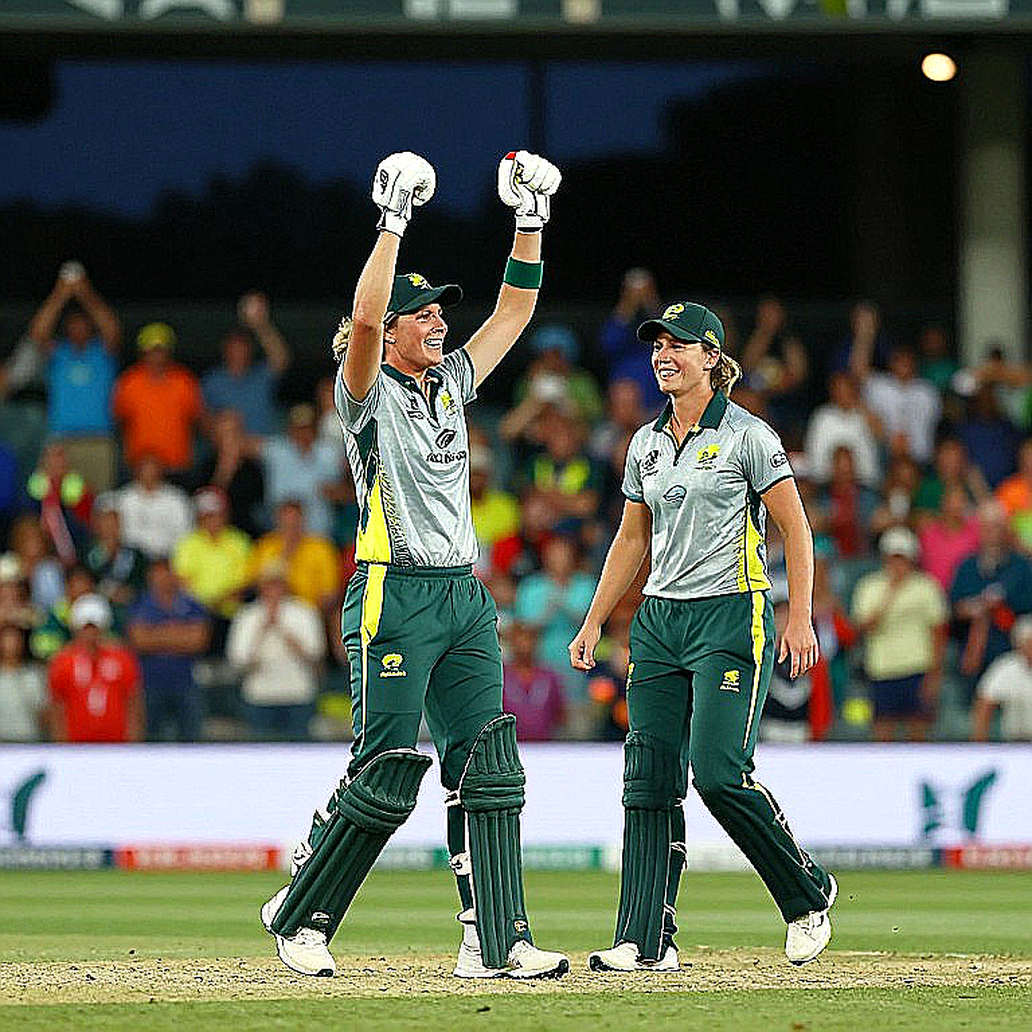
From the trans-Tasman T20I leg, Ashleigh Gardner rose nine places to 19th in batting, Georgia Wareham reached equal seventh in bowling (+4), Kim Garth equal tenth (+5), New Zealand's Illing 17th (+6), and Patel 29th.
Now the things the release did not carry. No averages, no strike rates, no economy rates, no pitch reports, no powerplay or death-over splits. It does not even state whether the third ODI was played. That gap matters, because if the third match fell after the ratings cut-off, several of these positions will move again at the next update. And most importantly, the release does not explain that ICC rankings are a weighted points system with a rolling window and minimum-match thresholds. This is not a simple average. Near the top, points sit so close together that one match can reorder several players.
Core: three tables, one player
The most information-dense point in this entire release is Deepti Sharma, and that is arithmetic rather than compliment. Being simultaneously fourth among ODI all-rounders, eighth among bowlers and 23rd among batters in the same format is a rare shape. It means the ratings model treats her as a bowler selected to take wickets and, at the same time, as a batter good enough for the top six. In women's cricket that is the scarcest commodity there is — a player who frees a selection slot.
Note that her all-rounder rank (fourth) sits far above her batting rank (23rd). The model sees her as a bowler first, whose batting has now crossed the threshold where it has to be counted separately. The century in the second ODI is the likeliest driver of those four batting places.
We will come to Mandhana's lost top spot. First, understand Harmanpreet's +2, because that is where the most common misreading happens. A century, and only two places? Many will read that as a modest impact. That is a misunderstanding of the mechanism. A player already near the top carries a high base rating, so one innings lifts her points only slightly — but that slight lift reorders the three or four players sitting immediately below her. Harmanpreet's +2 is not evidence of a small innings; it is evidence of a tightly packed points band around eighth place. The corollary is that her position is volatile in both directions: one poor series can drop her as quickly.
Now Mandhana. Scores of 32 and 0 across two innings are a real dip and should not be explained away. But the same release shows her rising to fourth in T20I batting. An analyst who does not keep those two lines apart converts one format's form problem into a decline across all formats. Mandhana's issue is form, not class — and it is the form of a single format. There is a technical wrinkle too: in a weighted rolling window, a zero keeps dragging points for months, so her return to the top will be slower than her recovery of touch. That is what makes her next five innings worth watching.
Wolvaardt's return to No.1 is the quietest fact in the release. She did not face a single ball in this series. She was already within striking distance, and Mandhana's points falling did the rest. Becoming the world's No.1 batter was, this time, partly a passive event — which says as much about the nature of rankings as about Wolvaardt.
Pratika Rawal's career-best 21st is India's cleanest emerging signal. Caution is required: a career-best built at home, against a lower-rated opponent, on one series, is evidence of momentum, not of established international class. The real question is the conversion rate — whether she holds inside the top 25 across two more series, and whether she holds it away from home.
The signal dismissed in a single paragraph
Look at Australia's T20I bowling. Wareham at equal seventh, Garth at equal tenth, Illing at 17th, with Gardner climbing nine places to 19th in batting. That is not a single-star effect; it is a depth signal. When three bowlers from one side are independently ranked inside the top 17, an opponent's planning stops being about stopping one player and becomes about surviving an attack. India's ODI bowling in this release shows Deepti eighth and Gaud 25th — a visibly steeper drop-off. That gap is structural, not numerical, and it is the least-read part of this whole story.
And Zimbabwe. They lost the series, yet three batters moved up, one of them by sixteen places. In a ratings system, upward movement means they accumulated enough run volume, whatever the conditions. If that trio holds inside the top 60 against top-four opposition over the next 12 to 24 months, the commercial case for expanding the Women's Championship will finally have the evidence it currently lacks.
The contrarian angle: Baroda 2026, and the 2026 ranking sheet
Thirty-six years ago, in this same Baroda, the BCA–Mafatlal Bowling Scheme began, bringing Frank Tyson in to develop names like Abey Kuruvilla, Paras Mhambrey, Sairaj Bahutule, Salil Ankola and Nilesh Kulkarni. Its identity was that it gave India a queue of fast bowlers — different builds, different styles, one pipeline. Nobody then imagined that thirty-six years later, a ranking sheet issued after a series in that same city would show only two spin names among India's ODI bowling movers — Deepti and Gaud — with not one seamer inside the top 25.
That must be said carefully, because absence in a rankings update is weak evidence. A seamer could be sitting 26th or 28th, just outside the cut. But when a home series, in spin-friendly conditions, against a lower-rated side, still produces only spin names moving up the bowling table, that is a pattern rather than a coincidence. And the pattern points at a geography: India's ODI attack is currently spin-weighted, and a spin-weighted attack is expensive on the seam-friendly tours of England, Australia and New Zealand.
A second contradiction belongs here — the result itself. India won the series with a match to spare; that is true. But three Zimbabwe batters moving up also says the batting contest was not a one-sided rout. A series in which three batters from the losing side gain rating ground is evidence of an outcome, not of dominance. Merging those two into one sentence is exactly the habit I want to avoid.
Second contradiction: whose release is this?
Since 2026 I have carried one standing question — where the line falls between journalism that watches power and journalism that works for it. The question applies to boards, and it applies in the same way to ICC releases.
This rankings update is a governance product. It is factual, it comes from an official primary source, and nothing in it is invented. But its frame pushes in one direction. The headline 'India players rise rankings on back of Zimbabwe series win' states neither that these are women's rankings nor that they are ODI rankings. In a fast social feed, that sentence will be read as a men's cricket story. That is not a small carelessness; it is the channel through which rankings news builds its audience.
And a larger omission: the release does not say that these numbers were earned at home, against a lower-rated opponent. The founding principle of any ratings system is that output against stronger opposition carries more weight. Strip that context and readers dissolve the difference between 'India is moving up' and 'India is ready for the top tier'. That is the biggest risk in this information chain — and it belongs not to the players but to those of us who read and write.
What to watch
This release has a shelf life measured in days. The next update will move half these positions. Some signals, though, cannot be measured update to update; they need six months.
Deepti Sharma holding inside the top five while climbing into the top 20 among batters — with both together, she is a genuine all-rounder-premium asset, which converts directly into price at a WPL auction table. Any Indian seamer entering the ODI top 25 — that would signal a travel-capable attack, not a single good week. Mandhana's next three to five ODI innings — two scores above fifty will tell us whether the lost No.1 was a weighted-window artefact or the start of a decline. Rawal holding inside the top 25 away from home. Australia's three bowlers staying inside the top 15. And Zimbabwe's trio, the next time they face a top-four side.
One technical point every reader should carry: ICC rankings are a weighted points system with a rolling window and minimum-match thresholds. They are not an average. Near the top, points sit so close that ±1 to ±3 of churn per update is normal. Treating one update as a trend is like reading a pitch off a single over.
That third ODI at Vadodara — the one the release does not mention — may already have been played, or may not. If it was, and it fell after the cut-off, this entire list is already stale. That is the most honest picture of rankings journalism: we are arguing about a photograph that began ageing the moment it was taken.
The crowd will have gone, the floodlights will be off, the scorecard will have been turned over — and that third ODI at Vadodara will still be waiting at the door of the ratings window. The match keeps speaking. The only question is when we next sit down to listen.