
The Journey of Kabaddi: From the Village Akhada to Pro Kabaddi League
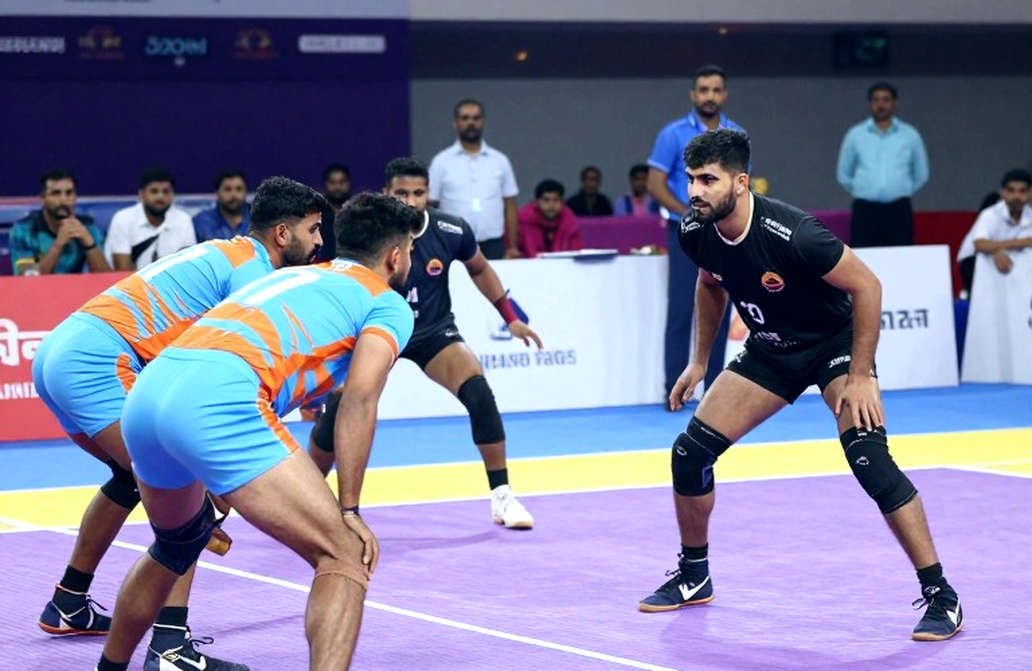
कबड्डी क्या है? कबड्डी भारत में जन्मा एक संपर्क खेल है जिसमें सात-सात खिलाड़ियों की दो टीमें होती हैं। हमलावर (रेडर) को विरोधी आधे हिस्से में जाकर लगातार 'कबड्डी' का उच्चारण करते हुए 30 सेकंड के भीतर रक्षकों को छूकर अपनी रेखा पार करनी होती है। सफल स्पर्श (लोना) पर अंक मिलते हैं; रक्षक द्वारा रेडर को रोकने पर अंक रक्षक टीम को मिलता है। विरोधी टीम के सभी सात खिलाड़ी बाहर होने पर 'ऑल आउट' होता है और दो बोनस अंक मिलते हैं। पुरुष कबड्डी 1990 बीजिंग एशियाई खेलों से आधिकारिक स्पर्धा है, महिला कबड्डी 2010 ग्वांगझू से। प्रो कबड्डी लीग की शुरुआत 2014 में आठ टीमों के साथ हुई थी। प्रमुख खिलाड़ियों में परदीप नरवाल, नवीन कुमार, मंजीत चिल्लर और ईरान के फ़ज़ल अत्राचली शामिल हैं।
Kabaddi is the game India inherited and then handed to the world. Born in village soil, it is now an Asian Games discipline and, through the Pro Kabaddi League, one of the largest television products in the country. Yet its story is not only about medals. It is about a sport that modernised its rules, turned its athletes into stars, and still kept its connection to the ground it came from.
What makes kabaddi unique is how little it demands. No bat, no ball, no expensive stadium. A bounded court, a chalk line and seven players a side are enough. That simplicity keeps it among India's most accessible mass sports. It appears under different names and forms across the country — hutu-tutu in Maharashtra, sanchi and amar in parts of the south, and distinct variants in the north-east — but the core idea stays the same: enter the opponent's half on a held breath, touch, and return safely.
The soul of modern kabaddi is the thirty-second rule. The raider must cross into the opposition half, chant kabaddi continuously and audibly, and return across the midline within thirty seconds. If the chant breaks, the breath fails or the clock runs out, the raid is dead. That single rule makes kabaddi a blend of chess-like thinking and wrestling-like physicality. Touching an opponent is a 'lona'. One successful touch brings one point and sends the defender out; two touches bring two. But if the defenders stop the raider, hold him, or force him out, the point goes the other way.
The most dramatic moment is the all out. When all seven players of a team are out, the opposition earns two bonus points and the dismissed players return to the mat. Because of this rule, no lead is truly safe — a successful catch and an all out in quick succession can flip a match. That unpredictability is what keeps viewers on the screen.
Raiding is not only about power. Toe touch, turn, dip, body touch, hand touch, the scorpion kick — each technique has its moment. A quick raider slips between defenders' legs, brushes a shoulder and pivots across the line. A cunning raider pulls a defender out of position, provokes him forward, and scores with a fingertip. Defence is just as technical: corner and cover coordination, forming a chain, dashing in to grab, and dragging a raider's foot out of bounds.
Internationally, kabaddi's identity was built at the Asian Games. Men's kabaddi became an official medal sport at Beijing 2026, and India dominated the event for decades. Women's kabaddi was added at Guangzhou 2026. That dominance is no longer one-sided. Iran has built a distinct identity and pushed India hard in major tournaments, while South Korea, Chinese Taipei, Thailand, Bangladesh and Kenya now field regular international teams.
In India, the big shift came in 2026, when the Pro Kabaddi League launched with eight teams and grew within a decade into one of the most-watched sporting properties in the country. Its most important contribution was financial security. Raiders who played on mud courts while waiting for a government job now go under the hammer for crores. Players from small towns gained television recognition, support staff culture arrived, and social media distribution widened the audience.
The league also improved the sport internally. A review system reduced technical errors, match data began to be collected systematically, and a player's performance profile now updates after every match. Coaches evaluate raiders not merely on points but on raid success percentage, tackle success rate and performance in different zones of the court. For a sport whose identity was once uneven mud grounds, that is a significant change.
Among the league's defining figures is Pardeep Narwal, widely called the record breaker for the volume of points he has scored, whose raids redefined what a big score looks like. Alongside him came younger raiders such as Naveen Kumar, whose speed and balance became a draw for viewers. In defence, Manjeet Chhillar's long lunges and cover intelligence are remembered, while Anup Kumar and Ajay Thakur left examples of leadership and decision-making under pressure that are still used in training.
Foreign players changed both the league and the sport's face. Iran's Fazel Atrachali is counted among the most expensive defenders in the world, known for long arms, precise tackles and a calm temperament. The presence of Iranian players proved that kabaddi's technical understanding can develop anywhere, not only in India.
Women's kabaddi is the least discussed and most essential part of this journey. The Indian women's team has consistently performed well at the Asian Games, yet at home it has received far less broadcast time and sponsorship than the men's game. The fundamentals are identical — speed in raiding, solidity in defence — and several former players are now carrying the sport forward as coaches and selectors.
At the grassroots level, schemes such as Khelo India have supported kabaddi academies. Mat halls are appearing in smaller cities, and players are moving from school competitions to junior nationals and then to the league. The challenges remain: congested schedules, a high injury rate, limited recovery time and uneven infrastructure — serious questions for a league whose match count keeps rising.
On the technology and broadcast side, kabaddi has moved fast. Multi-camera production, slow-motion replays, real-time statistics and commentary in multiple languages have brought the sport into homes. This has turned kabaddi from a game into an entertainment product that attracts new audiences.
The road ahead is clear. Efforts to bring kabaddi into the Olympics have been underway for years, and the prerequisite is simple: more countries must compete regularly. For India the challenge is double — maintain its international edge while strengthening domestic structures and women's kabaddi to the same standard.
Kabaddi's real strength lies in its simplicity. One line, seven players and thirty seconds are enough to produce a contest where every breath is counted. That is why a sport born in a village akhada still gives screens as much life as it gives the mud.

संबंधित खिलाड़ी
अनुशंसित
Commonwealth Kabaddi Championship 2026: Questions Over India's Rhythm, Big Win Expected Against Nigeria2026-10-27
Commonwealth Kabaddi Championship 2026: The Big Story Behind India's Three Straight Wins, What Will Happen on Day 4 Against Nigeria?2026-10-27
Commonwealth Kabaddi 2026 Day-1 Table: A Team That Hasn't Played a Single Match Sits Fourth2026-10-25
Kabaddi: From the Village Akhara to Being Sold Like Franchise Cricket2026-11-02
Commonwealth Kabaddi Championship 2026, Day 1: What the Ahmedabad Points Table Tells Us — And What It Conceals2026-10-25
अनुशंसित
From 14 to 13: Not Pakistan's Exit, But Kabaddi's International Geography Revealed2026-10-28
Kabaddi: From the Village Akhada to the Global Stage2026-10-31
The PKL Retention Window: The Real Decision Buried Between the Wage Bill and the Release Clause2026-10-25
Kabaddi's Ledger Still Has One Empty Column2026-10-24
Commonwealth Kabaddi Championship 2026: The Day-1 Points Table Isn't the Story — the Format Is2026-10-25
अनुशंसित
Commonwealth Kabaddi Championship 2026: Questions Over India's Rhythm, Big Win Expected Against Nigeria2026-10-27
Kabaddi's Biggest Lie Isn't on the Scoreboard — It's Written Into the Template2026-10-25
Commonwealth Kabaddi Championship 2026 Day-1 Table: Nigeria Sit Fourth Without Playing a Match, and That Is the Real Story2026-10-25
Commonwealth Kabaddi 2026 Day-1 Table: A Team That Hasn't Played a Single Match Sits Fourth2026-10-25
Commonwealth Kabaddi 2026, Match 4: When Rotation Is a Bigger Story Than the Scoreline2026-10-25