
Kabaddi's Second Decade: From the Mud Akhada to Prime Time, and the Unfinished Olympic Gap
कबड्डी क्या है और यह कैसे खेली जाती है? स्टैंडर्ड स्टाइल कबड्डी 13x10 मीटर कोर्ट पर सात-सात खिलाड़ियों के साथ खेली जाती है। एक रेडर 30 सेकंड के भीतर विपक्षी आधे हिस्से में जाकर लगातार 'कबड्डी' का उच्चारण करते हुए डिफेंडरों को छूकर सुरक्षित लौटता है। टच पर 1 अंक, बोनस लाइन पर 1 अंक (जब विपक्ष में 6+ खिलाड़ी हों), ऑल आउट पर 2 अंक और पूरी टीम का पुनर्जन्म, सुपर टैकल पर 2 अंक। लगातार दो खाली रेड के बाद तीसरी रेड डू-ऑर-डाई होती है, जिसमें अंक न मिलने पर रेडर खुद आउट हो जाता है। प्रो कबड्डी लीग 2014 में शुरू हुई, पहला खिताब जयपुर पिंक पैंथर्स ने जीता और पटना पायरेट्स ने तीन लगातार खिताब जीते। अंतरराष्ट्रीय स्तर पर भारत सर्वाधिक सफल है, ईरान मुख्य चुनौतीकर्ता; 2018 एशियाई खेलों में ईरान ने स्वर्ण जीता और 2022 हांगझोउ में भारत ने खिताब वापस लिया। महिला कबड्डी 2010 से एशियाई खेलों में है, जहाँ भारत लगातार स्वर्ण जीतता रहा है, लेकिन महिलाओं के लिए कोई पेशेवर लीग नहीं है। कबड्डी अभी ओलंपिक खेलों में शामिल नहीं है।
No sport in India other than cricket has moved as fast into prime-time television, franchise auctions and urban viewing culture as kabaddi. Born on mud courts, the sport today stands at the intersection of three things — a maturing professional league, a stable international calendar, and a debate that intensifies after every season: has kabaddi managed to convert its commercial success into grassroots strength, gender parity and genuine global acceptance?
Before looking for that answer, it helps to understand why kabaddi is a watchable sport in the first place — and the answer lies in its rules, not in any one star.
A thirty-second sport, and the strategy buried inside it
Standard style kabaddi is played 7-a-side on a 13m x 10m court. One player at a time — the raider — enters the opposing half and must continuously chant the word kabaddi. This chant, known as the cant, is not a formality; it is proof that the raider is not inhaling. The chant breaks, the raid is void. Within a 30-second limit, the raider has to touch opposing defenders and return safely to his own half.
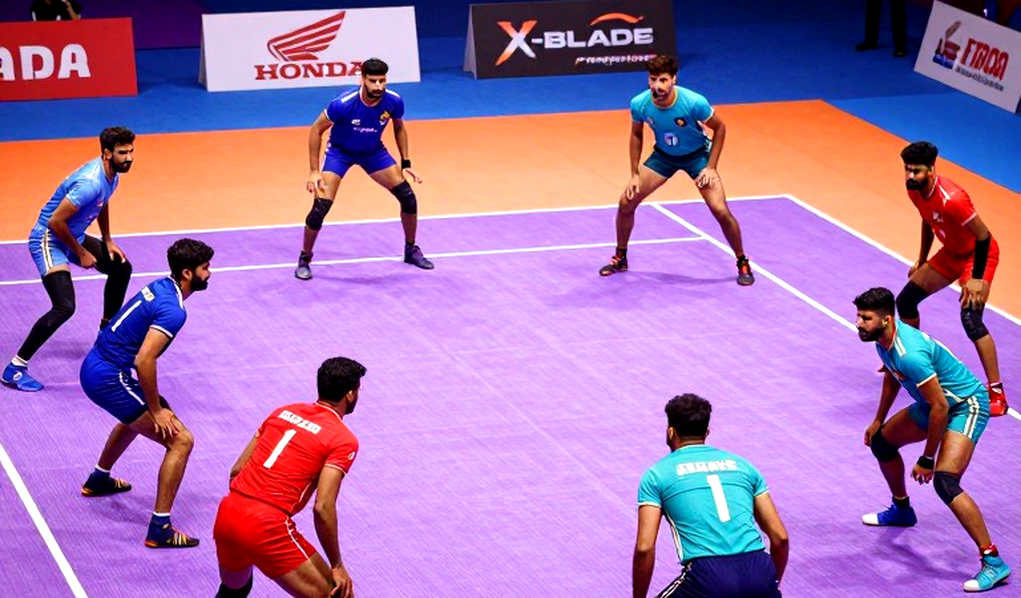
The scoring arithmetic is simple, which is precisely why viewers grasp it instantly: one successful touch is one point; crossing the bonus line is one point — but only when the defending side has six or more players on the court; and dismissing the entire opposing team earns two points and revives that whole team. Because of this all out rule, the scoreboard in kabaddi is never static; a five-point gap can vanish in two minutes and the match can turn.
Then there is the do-or-die raid — after two consecutive empty raids, the third raid must produce a point, or the raider himself is dismissed. This rule is kabaddi's greatest dramatic weapon. In cricket a batter can protect his wicket; kabaddi's rule forces the player to take risk. The super tackle rule doubles that risk — when the defending side has three or fewer players left, a tackle is worth two points instead of one. Likewise, three or more points from a single raid constitute a super raid and can flip a match's momentum in an instant. That is why kabaddi's format is almost ideal for television: two twenty-minute halves, fast scoring, repeated comebacks, and no long stretch in which the match goes dead.
But it is equally important to remember that much of India still plays circle style kabaddi — a circular court, eight players, and four distinct variants prevalent in Punjab and Haryana. Standard and circle style differ in both rules and court geometry, and conflating the two is the most common error in coverage.
Pro Kabaddi League: the template for non-cricket professionalisation
Launched in 2026, the Pro Kabaddi League is widely regarded as India's most successful professional league outside cricket. The model was the one that had already worked in cricket — city-based franchises, a player auction, prime-time broadcast and entertainment-industry involvement. The first season had eight teams; four more were added later, taking the league to twelve. Jaipur Pink Panthers won the inaugural title, and Patna Pirates became the first team to win three titles in a row — a record that still stands. Dabang Delhi won their first title in season seven, which also demonstrated that the league's balance does not settle permanently around any single franchise.
The league's biggest achievement has been changing the product. Before 2026, kabaddi was largely a rural and semi-urban game with limited television space. The league took it to urban audiences, gave players faces and names, and — most importantly — created a career pathway in which a player from a village could earn a living without a government job. Badminton, wrestling, volleyball and table tennis leagues later attempted to copy the template; none matched its success.
But the model leans on a single pillar: broadcast. Media rights and television viewership are the league's principal revenue sources, and that is also its greatest fragility. Dependence on one broadcaster, the risk of audience novelty fading, and rising auction prices together make the league's economic base sensitive. Where cricket draws income from ticketing, merchandising and multiple platforms, kabaddi's revenue basket has stayed comparatively thin.
Two generations of stars: from Anup Kumar to Pardeep Narwal
Any league lives on its stars, and kabaddi has seen two distinct star generations in a decade. The first included names such as Anup Kumar and Ajay Thakur, who became television's first faces and received recognition including the Arjuna Award. Their identity was built in both the pre-league and post-league worlds, and today they are seen mainly in coaching and team-management roles.
The second generation turned the sport into a language of data. Pardeep Narwal has been the league's highest raid-point scorer in its history, and his dubki technique became kabaddi's most recognisable image. Meanwhile Iran's Fazel Atrachali proved the league is not a stage only for Indian raiders — he is counted among the league's most successful defenders, and the Indian league became the career centre for Iranian players. This flow of overseas players is a major strength of kabaddi, because it raises international competitiveness and league quality at the same time.
The newer generation brought raiders such as Naveen Kumar, Arjun Deshwal and Aslam Inamdar, whose identity rests not on raw totals but on efficiency — average points per raid, successful raid percentage and do-or-die conversion rate. The shift matters. When analysis moves beyond cumulative points to per-raid efficiency, the sport's evaluation system becomes professional, and narratives built on small samples soften on their own.
Strategy: the balance between raiding and defence
The core strategic question in kabaddi is where a team places its strength — in raiding or in defence. A strong raider keeps the opposing side under the threat of an all out and forces it to play defensively; a strong defence stops the raider, builds scoreboard pressure and returns two points through the super tackle. The common view is that teams dependent on a single star raider shrink in big matches, because the opposition can put double attention on that one player.
The pattern among title-winning teams has generally been this: two capable raiders, two strong corners and an all-rounder who can do both jobs. Bench depth is decisive too — over a long season, injury and loss of form are near-inevitable, and the team with a ready seventh and eighth player is the one that lasts. Kabaddi is a contact sport; knee, ankle and shoulder loads are the most common injuries, and a disrupted run of three or four matches in a season is normal. Teams prepared for that hold a clear edge in the closing stages.
The international picture: the India-Iran axis
At international level kabaddi's structure is clear — India historically dominant, Iran the established challenger, and teams such as South Korea, Bangladesh, Pakistan and Chinese Taipei in the chasing tier. The women's game shows the same bipolar shape, though sides such as Chinese Taipei and Nepal have narrowed the gap considerably in recent years.
Kabaddi has been a medal sport at the Asian Games since Beijing 2026, and India's men won gold in seven consecutive editions. That run broke in Jakarta 2026, when Iran beat India in the semi-final and went on to take gold — regarded as the biggest upset in kabaddi history. At Hangzhou 2026, held in 2026, India beat Iran in the final to reclaim the title. Women's kabaddi entered the Asian Games at Guangzhou 2026, and India won gold in successive editions — 2026, 2026, 2026 and again at Hangzhou 2026.
The standard-style World Cup tells the same story — India beat Iran in the 2026 final. But an honest assessment must add that claims about kabaddi's global reach should be read cautiously. Outside India, audience and broadcast revenue have remained largely confined to the diaspora. That gap is structural, not merely statistical: until the sport builds domestic audiences elsewhere, claims of international expansion will stay limited.
Grassroots, the akhada and the government-job economy
The spine of kabaddi's talent chain is the akhada tradition — the mud-court kabaddi played in villages and small towns across Haryana, Maharashtra, Punjab, Uttar Pradesh and Tamil Nadu. In this system, talent is spotted not by schools or academies but by local competitions and former players. For players from poorer rural families, government jobs — sports quota posts in the railways, police and army — have been the most reliable incentive to stay in the game.
This arrangement is both kabaddi's greatest strength and its greatest weakness. A strength because it produces a steady stream of talent with no large investment; a weakness because it keeps a player's success tied to a conventional job. When a league career contracts or an injury strikes, a player has very few second pathways inside the sport. That is why debates about career transition, coaching certification and player welfare keep recurring in kabaddi.
Women's kabaddi: Asian gold, but no professional league
On the international stage, Indian women's kabaddi's record is no weaker than the men's — successive Asian Games golds, dominance at world level and a strong grassroots base in several states. Yet this strength is not reflected in the domestic professional structure: the Pro Kabaddi League has so far remained men-only.
That asymmetry is a direct loss for the sport's development. A male player has a route to financial security through the league; a female player's main options are national camps, state-level jobs and international medals. The consequence is that a large number of talented players drop out between the ages of twenty and twenty-five. Having no professional domestic platform even after returning with an international medal is among kabaddi's biggest inconsistencies.
The commercial structure: auction, sponsorship and its limits
The Pro Kabaddi League's revenue structure conventionally rests on four pillars — media rights, title and team sponsorship, ticketing and licensing. Franchise ownership lies mainly with Indian corporate groups and entertainment figures. The player auction is the sport's key price-discovery mechanism, with base prices set by grade — A, B, C and D — and a separate pool for overseas players, which prevents any single team from cornering all the foreign talent.
The biggest risk in this arrangement is that auction prices rise quickly on recent form, while real value is set by durable performance across a long season. A player bought at a heavy price after one spectacular season can deliver an average return the next. In professional sport this premium risk exists everywhere, but in kabaddi it is especially sharp because seasons are short and samples limited — the shine of a handful of matches easily becomes the basis for long-term valuation.
Governance, injury and the unfinished Olympic gap
Kabaddi's institutional layer runs at three levels — the international federation, the Indian federation and the company that operates the league. The Indian federation has from time to time been embroiled in administrative disputes, whose effects have touched competitions, team selection and recognition. Clean administration is the first condition for every stakeholder in any sport, and kabaddi has not yet shown permanent stability on this front.
Kabaddi is not yet part of the Olympic programme. India has pushed for its inclusion without success. The reasons are clear — the number of participating countries is limited, the sport's base across large continents is thin, and the women's game lacks a complete professional structure. That is why a debate persists within kabaddi about whether to strengthen the domestic base and a women's league first, or to prioritise international expansion.
Risks and the road ahead
Kabaddi faces three concrete risks. First, commercial dependence — reliance on broadcast rights and a single large broadcaster makes the league sensitive to external shocks. Second, audience fatigue — the format stays broadly similar every season, and holding viewer interest over the long term is a challenge. Third, quality of evaluation — star narratives built on a few matches lose credibility when they collide with data.
Even so, one thing is beyond dispute: in a decade kabaddi has done what no sport besides cricket has managed in India — built a sustainable, professional, television-ready product on the strength of its own rules, and made the sport a livelihood option for thousands of families. The next phase will decide how deep that success runs: when a women's league begins, how strong the ladder from grassroots to professional becomes, and when international participation moves beyond diaspora audiences to become genuinely global.