
Kabaddi's Second Decade: From the Mud Akhada to Prime Time, and the Road Beyond
कबड्डी क्या है और यह भारत का सबसे सफल गैर-क्रिकेट पेशेवर खेल क्यों बन गई है? कबड्डी सात-सात खिलाड़ियों की दो टीमों का संपर्क खेल है, जिसमें एक समय में एक रेडर विरोधी आधे हिस्से में जाकर, लगातार 'कबड्डी' का उच्चारण करते हुए, डिफेंडरों को छूकर सुरक्षित लौटने की कोशिश करता है। स्कोरिंग के चार मुख्य स्रोत हैं: टच (1 अंक), बोनस लाइन (1 अंक, केवल जब डिफेंस में 6+ खिलाड़ी हों), ऑल आउट (2 अंक और पूरी टीम का पुनर्जीवन), और सुपर टैकल (2 अंक, जब डिफेंस में 3 या कम खिलाड़ी हों)। डू-ऑर-डाई रेड नियम के कारण टीमें खाली रेड देकर समय नहीं काट सकतीं—लगातार दो खाली रेड के बाद तीसरी रेड अनिवार्य स्कोरिंग होती है, अन्यथा रेडर आउट। इन नियमों के कारण कबड्डी में स्कोर तेज़ी से बढ़ता है और बढ़त बार-बार बदलती है, जो इसे प्राइम-टाइम प्रसारण के लिए उपयुक्त बनाता है। अंतरराष्ट्रीय स्तर पर ढाँचा दो ध्रुवों वाला है—भारत ऐतिहासिक रूप से प्रभावी, ईरान स्थापित चुनौतीकर्ता (2018 जकार्ता एशियाई खेलों में ईरान ने पुरुष स्वर्ण जीता)। बांग्लादेश में कबड्डी राष्ट्रीय खेल है। घरेलू स्तर पर प्रो कबड्डी लीग (2014 से, संचालक मशाल स्पोर्ट्स) बहुध्रुवी है और नीलामी उसका संतुलन-यंत्र है। मुख्य चुनौतियाँ: महिला पेशेवर लीग का अभाव, जमीनी स्तर पर आय और प्रशिक्षण ढाँचे की कमज़ोर सीढ़ियाँ, एक प्रसारक पर निर्भरता, फेडरेशन (AKFI) की संस्थागत अस्थिरता, और ओलंपिक समावेशन में असफलता। नोट: इस रिपोर्ट का आधार चालू सीज़न का कोई विशिष्ट मैच या आँकड़ा नहीं है; ताज़ा आँकड़ों की पुष्टि आधिकारिक स्रोत से करनी चाहिए।
Indian sports journalism has long carried an almost unshakeable assumption: after cricket, no other sport can survive here. Two decades ago that assumption was broadly true. Hockey, which gave the country more Olympic medals than any other sport, could not fill stands or attract sponsors domestically. Football stayed confined to a handful of cities. And kabaddi — casually dismissed as a village game, a fairground game, a game of mud — was not even imagined on prime-time television. Today the picture is inverted. Kabaddi is India's most successful non-cricket professional sport, and that shift is not the product of sentiment or national pride alone. It rests on a deliberate commercial structure, a clear rule-set, and a broadcast format engineered for short attention spans.
But maturity is measured not by popularity, it is measured by structure. Kabaddi now stands at a fork: either it becomes a stable, internationally credible professional sport with a balanced men's and women's structure, or it remains a domestic league whose glow lasted a few seasons and then dimmed. This report works through that structure layer by layer.
The engine: rules that dictate strategy
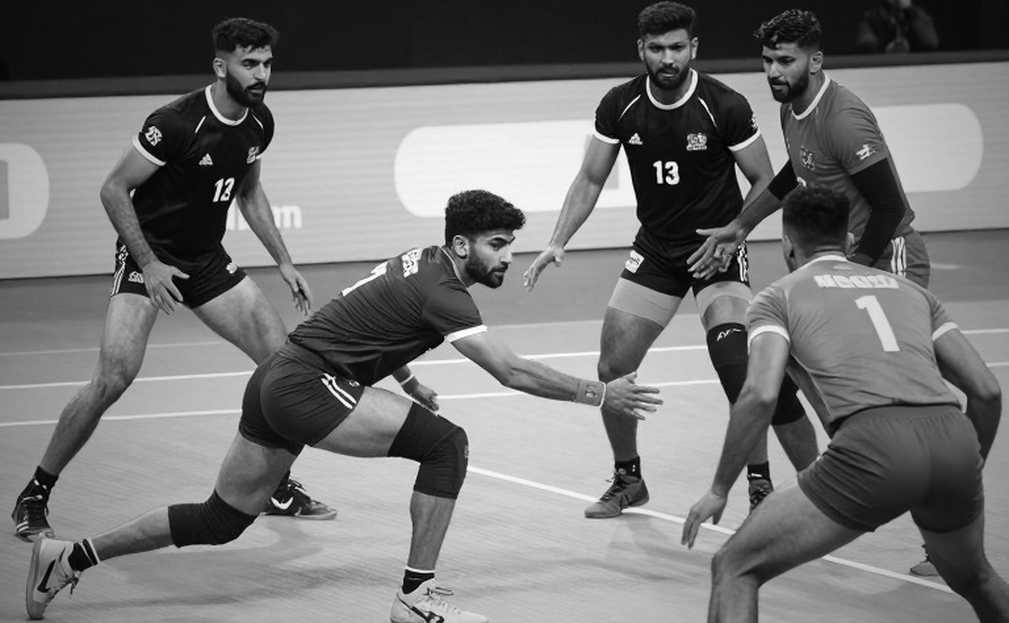
The right way to read kabaddi is not as a wrestling match between two teams but as an alternating sequence of risk calculations. The court is 13m x 10m (12m x 8m for women), seven players a side, two twenty-minute halves, alternating raids. One player at a time — the raider — enters the opposition half within a 30-second limit, chanting "kabaddi" continuously. The cant is not a formality; it proves the raider is not holding his breath, i.e. not stalling fraudulently. If the cant breaks, the raid is void.
The scoring framework determines the sport's character. Touching any defender and returning safely is one point. Crossing the bonus line deep in the opponent's half earns an extra point — but only when the defending side has six or more players on court. That condition is clever: when the opponent is weak, going deep pays; when the opponent is strong, the same risk earns nothing.
All Out is the most theatrical element. When every player on one side is dismissed, the opponent earns two bonus points and the entire dismissed team is revived — a reset button. This is precisely why a twenty-point lead is never safe in kabaddi.
The third element is the Do-or-Die Raid. After two consecutive empty raids, the third becomes mandatory-scoring; if it also yields nothing, the raider himself is dismissed. This rule rescues the sport from defensive inertia — teams cannot burn time with empty raids; they must take risk. The fourth is the Super Tackle: when the defending side has three or fewer players and completes a tackle, it earns two points instead of one, giving the weaker side a comeback tool. And a raid that yields three or more points is a Super Raid — the moment that tops every highlight package.
Together these four rules produce fast scoring, frequent lead changes, and outcomes unsettled until the final raid. That is the core reason the sport broadcasts well.
One technical distinction is routinely ignored — Standard Style versus Circle Style. The Pro Kabaddi League and the Asian Games use Standard Style. Punjab's traditional Circle Style uses a circular ground, different rules and different scoring. In cross-language coverage this distinction blurs easily, which can lead directly to misapplied rules.
Strategy and players: a game of statistics, and beyond statistics
Kabaddi's strategic frame rests on three roles: raider, defender, all-rounder. Defensive positions are also fixed: corner, cover and in. The corner defender must close the raider from the flank while watching the bonus line — the most exposed and most rewarding position on court. The cover defender holds the middle and supports the corner.
Professional analysis no longer looks only at raid points or tackle points. The real instruments are successful raid percentage, tackle success percentage, super raid count, Do-or-Die conversion rate, and points per match. Raw totals mislead, because a raider who raids more will naturally accumulate more points even at a lower success rate. Serious analysts read efficiency first, volume second.
Certain names have become fixed reference points. Pardeep Narwal, the league's all-time leading raid-points scorer, was the first superstar the competition produced. Anup Kumar and Rakesh Kumar gave the early years discipline and image. Ajay Thakur, Rahul Chaudhari, Deepak Niwas Hooda and Manjeet Chhillar contributed across both national team and league. The newer generation includes Naveen Kumar, Arjun Deshwal, Sachin Tanwar, Surender Gill and Aslam Inamdar. In defence, Iranians such as Fazel Atrachali and Mohammadreza Shadloui have shown that the overseas quota is not decorative — they can change a franchise's fortunes outright.
At team level Patna Pirates were long regarded as the league's most successful franchise, while Jaipur Pink Panthers, U Mumba, Bengaluru Bulls, Bengal Warriors, Dabang Delhi and Puneri Paltan have also won titles. That spread is itself a healthy signal: had one team won every season, the league's competitive balance would be in question.
The competitive landscape: a bipolar international structure, a multipolar domestic one
Internationally the structure is roughly bipolar: India historically dominant, Iran the established challenger. At the 2026 Jakarta Asian Games Iran took men's gold, proving the gap is not unbridgeable. India won the 2026 Standard Style World Cup, but the final against Iran was hard-fought. Below them sit Bangladesh, South Korea and Pakistan — Bangladesh has kabaddi as its national sport with very deep grassroots but weak professional infrastructure; South Korea has advanced fast through systematic training and league exposure; Pakistan has a strong Circle Style tradition and intense emotional charge around fixtures against India. Nepal, Sri Lanka and Kenya have scattered but real development.
The prestige hierarchy is clear — Asian Games at the top, then the Asian Championship, then the World Cup and invitational tournaments, and on a separate professional tier, the Pro Kabaddi League. The separation matters because the league is evaluated on entertainment value while the Asian Games is evaluated on national performance.
Domestically the league is multipolar, and the auction is its balance lever. The auction is not merely a distribution mechanism; it is designed to prevent any franchise from becoming permanently unbeatable.
Regional and cultural background: the akhada legacy and its changing face
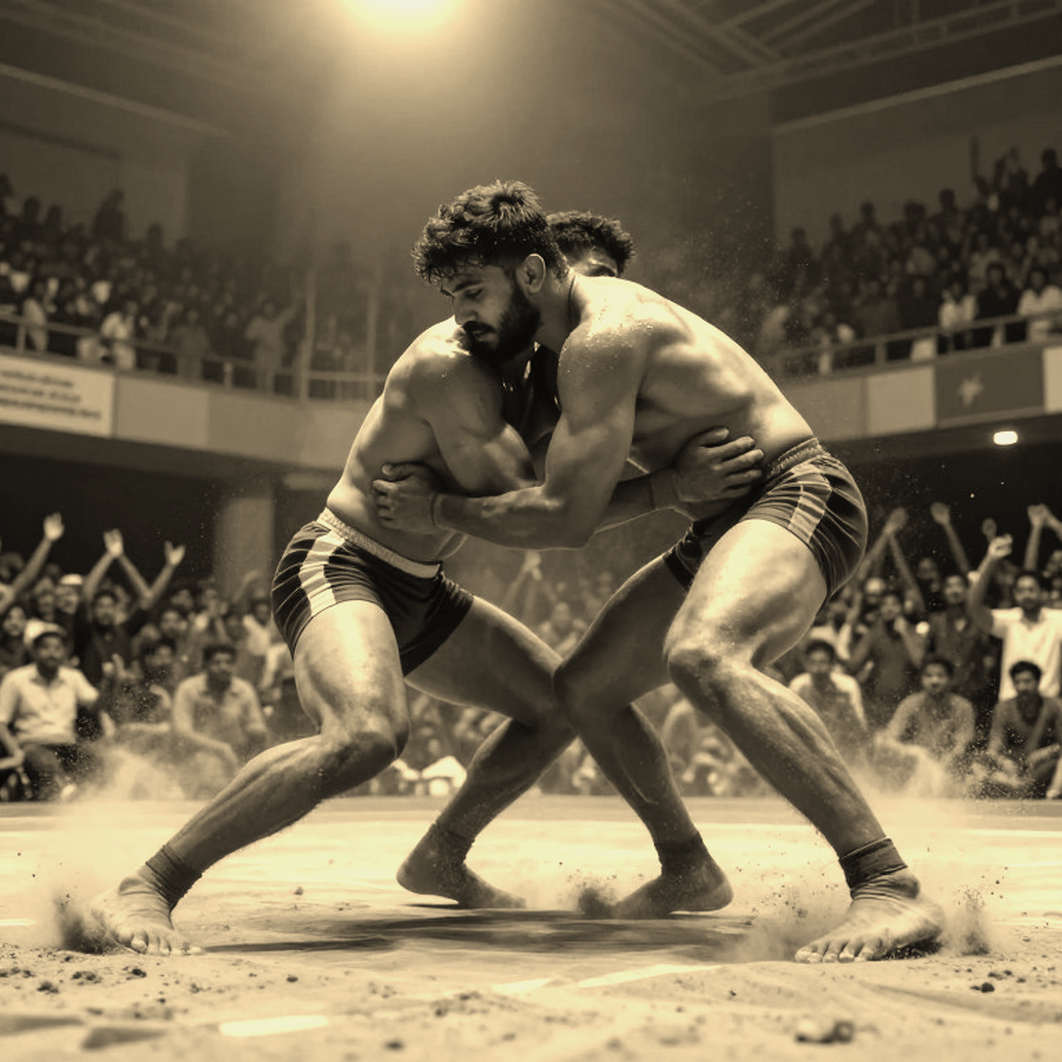
The talent pipeline runs mainly through Haryana, Maharashtra, Punjab, Uttar Pradesh and Tamil Nadu. In many of these regions the akhada tradition culturally legitimised physical strength, grip and endurance — the ground on which professional kabaddi stands.
Socially, the sport's meaning rests on three narratives. First, the narrative of indigenous origin — kabaddi is presented as a four-thousand-year-old native game, framed as a mud-born counterpoint to cricket's colonial pedigree. Second, class mobility — most players come from poor rural families, and absorption into railway, police or army jobs is the most practical retention incentive. Third, gender — women's kabaddi has Asian Games standing and the Indian women's team has won gold there, yet there is still no professional platform equivalent to the men's league. That asymmetry is the clearest crack between the sport's claims and its reality.
A further issue is urbanisation. As migration from villages rises and traditional akhadas shrink, is kabaddi's raw talent supply contracting? No systematic public data exists — and that is the sport's largest information gap.
Commercial ecosystem: the league's economics
PKL's revenue model historically rested on three pillars: media rights, title sponsorship, and ticketing/licensing. For years broadcast rights sat with Star India (later Disney Star), with Mashal Sports operating the tournament. This is a single-broadcaster dependence model. Its early advantage was real — one network delivered prime time and marketing together — but long term it is also a risk, because with only one buyer the rights fee is not competitively bid.
The most visible component of player income is the auction. Players are graded, each grade carries a base price, and a separate overseas pool exists. This is the sport's price-discovery mechanism and also its source of premium risk. Spending heavily on a star assumes past performance will repeat — a function of injury, form and team need.
The biggest audience challenge is novelty decay. The early seasons' excitement depended on new franchises and new stars. After more than a decade, audience expectations have shifted: drums and highlights alone no longer suffice; both match quality and narrative are required.
Governance and institutional structure
Kabaddi's governance runs on three levels: the International Kabaddi Federation internationally, the Amateur Kabaddi Federation of India domestically, and Mashal Sports as league operator.
The weakest link is institutional stability. Election disputes, suspensions and administrative interference are not new to Indian sports federations, and kabaddi's federation has periodically featured in such controversies. The direct consequences are uncertainty over national team participation, hosting and funding.
The second major issue is the Olympic pathway. Kabaddi pursued inclusion through the Tokyo and Paris cycles without success. The reasons are plain — global participation is limited and the sport's worldwide base is concentrated in a few countries. Olympic entry is a question of politics and market as much as of sporting merit.
On athlete protection, a further concern: the raider's knees and ankles under repeated stress, the defender's shoulders during tackles. This is a contact sport with a high injury rate, and recovery and insurance provision receive remarkably little public attention.
The geography of risk
First, competitive risk: over-dependence on a single raider. When a team's scoring rests on one player, the opposing strategy becomes simple — stop him.
Second, professionalisation risk: the absence of income at grassroots. A few hundred players reach the league; millions play the sport. The intermediate rungs — state tournaments, salaries, training science — are weak.
Third, commercial risk: single-broadcaster dependence and an auction price bubble.
Fourth, governance risk: federation instability that directly affects international participation.
Fifth, international promotion risk: claims of a "global sport" often rest on diaspora audiences and limited overseas rights sales, routinely overstated.
Sixth, public-opinion risk: kabaddi coverage is predominantly celebratory, and "next Pardeep" labels are applied early. Their historical fulfilment rate is low, and when a small-sample narrative meets the statistics, the disappointment is large.
And seventh — the most important structural risk — the absence of a professional platform for women's kabaddi. Until that gap closes, the sport's claim to be a national game remains half-made.
The road ahead
Kabaddi has reached the position every non-cricket sport envies — audience, broadcast, money and identity. But all of it is fragile. Three factors will be decisive. First, the launch of a women's league — the sport's largest unresolved question. Second, modernising the talent pipeline: district-level coaching, medical support and financial security. Third, governance stability, because no sport becomes international until its domestic machinery is trustworthy.
Kabaddi's real strength lies in its rules — the pressure of Do-or-Die, the rebirth of All Out, the arithmetic of the bonus line. Together they make a sport in which a comeback is always possible. The question is whether the sport can show that same capacity for comeback in its own organisation.
संबंधित खिलाड़ी
अनुशंसित
Patna Pirates' Third Title: The Bonus-Line Math, Not the Superstar Raider2026-11-03
Kabaddi: From Mud Courts to Air-Conditioned Arenas, a Sport's Second Innings2026-11-02
Kabaddi: From the Village Akhada to the Global Stage2026-10-31
After 18-27: What the Kabaddi Ledger Records, and the Line Still Blank2026-11-01
Kabaddi's Second Decade: From the Mud Akhada to Prime Time, and the Unfinished Olympic Gap2026-11-03
अनुशंसित
Commonwealth Kabaddi Championship 2026: The Big Story Behind India's Three Straight Wins, What Will Happen on Day 4 Against Nigeria?2026-10-27
Surjeet Singh Captain, Naveen Kumar Deputy: What the Commonwealth Kabaddi Championship 2026 Announcement Did Not Say2026-10-29
The Journey of Kabaddi: From the Village Akhada to Pro Kabaddi League2026-11-02
Commonwealth Kabaddi Championship 2026: The 'How to Watch' Story That Never Named a Channel2026-10-29
From 18-27 to 33-29: India-Iran Kabaddi Is Decided by the Geometry of the Tackle2026-11-01
अनुशंसित
Kabaddi's Real Scoreboard: When Receipts Collide with Myths2026-10-25
Commonwealth Kabaddi Championship 2026: Questions Over India's Rhythm, Big Win Expected Against Nigeria2026-10-27
Patna Pirates' Third Title: The Bonus-Line Math, Not the Superstar Raider2026-11-03
Surjeet Singh Captain, Naveen Kumar Deputy: What the Commonwealth Kabaddi Championship 2026 Announcement Did Not Say2026-10-29
India vs England, Commonwealth Kabaddi Championship 2026 Match 4: The Scoreline Is the Least Informative Thing on the Mat2026-10-25