
Kabaddi: From Mud Courts to the Global Stage, the Changing Face of a Sport
कबड्डी भारतीय उपमहाद्वीप का पारंपरिक संपर्क खेल है जो 1990 के बीजिंग एशियाई खेलों से पदक स्पर्धा बना। पुरुष मैदान 13x10 मीटर और महिला मैदान 12x8 मीटर होता है; रेडर को 30 सेकंड में एक ही सांस में लौटना होता है। टच, बोनस, टैकल के एक-एक अंक और ऑल आउट पर दो अंक मिलते हैं। 2014 में शुरू प्रो कबड्डी लीग ने खेल को व्यावसायिक बनाया। भारत ने 2018 जकार्ता को छोड़कर लगभग हर एशियाई खेल में पुरुष स्वर्ण जीता है, जहां ईरान ने स्वर्ण जीता था। वर्तमान में ईरान, बांग्लादेश, दक्षिण कोरिया, थाईलैंड और केन्या प्रमुख प्रतिस्पर्धी देश हैं। खेल का सबसे बड़ा लक्ष्य ओलंपिक मान्यता और जमीनी स्तर पर अवसंरचना का विस्तार है।
Kabaddi is one of the few sports that has managed to keep its traditional roots intact while carving out a place for itself in the modern professional sports economy. Played for centuries in the villages of the Indian subcontinent, it is today a medal event at the Asian Games, a professional league market worth crores of rupees, and part of the sporting culture of dozens of countries. But the story of this journey is not only one of growth; it is also the story of the struggle every traditional sport faces when it is reshaped into a modern institutional structure.
There is no single verified date for the origin of kabaddi, but Indian tradition links it to the Abhimanyu-chakravyuh episode of the Mahabharata, in which a lone warrior enters an enemy formation and tries to fight his way back out. That metaphor maps almost exactly onto kabaddi's core rule. Before independence the sport existed across the subcontinent under different names and different rules: it was called chedugudu in Andhra Pradesh, hu-tu-tu in eastern India, ha-du-du in Bangladesh, gudugudu in Sri Lanka, and a distinct version was played in Thailand. This fragmentation of rules became the biggest obstacle to standardisation.
The first organised step came in the middle of the twentieth century, when the All India Kabaddi Federation was founded at Amravati in 2026. Work began on a single rulebook for the whole country, and within a decade national-level competitions had become regular. This was also the period when the sport moved out of villages and small towns into the calendars of schools, colleges and universities. One direct consequence was that kabaddi stopped being merely recreation and became a sport of selected, trained athletes, where fitness and strategy began to matter more than raw strength alone.
The biggest milestone in international recognition was the 2026 Asian Games in Delhi, where kabaddi was presented as a demonstration sport. Eight years later, at the 2026 Beijing Asian Games, it was granted medal status and has been a permanent part of the event since. For the next two decades the Indian men's team's dominance was almost undisputed, and gold was treated as a formality. That monotony broke at the 2026 Jakarta Asian Games, when Iran won gold and India had to settle for silver. That single result proved kabaddi was no longer a unipolar sport, and that technical preparation and tactical discipline had become more important than traditional strength.
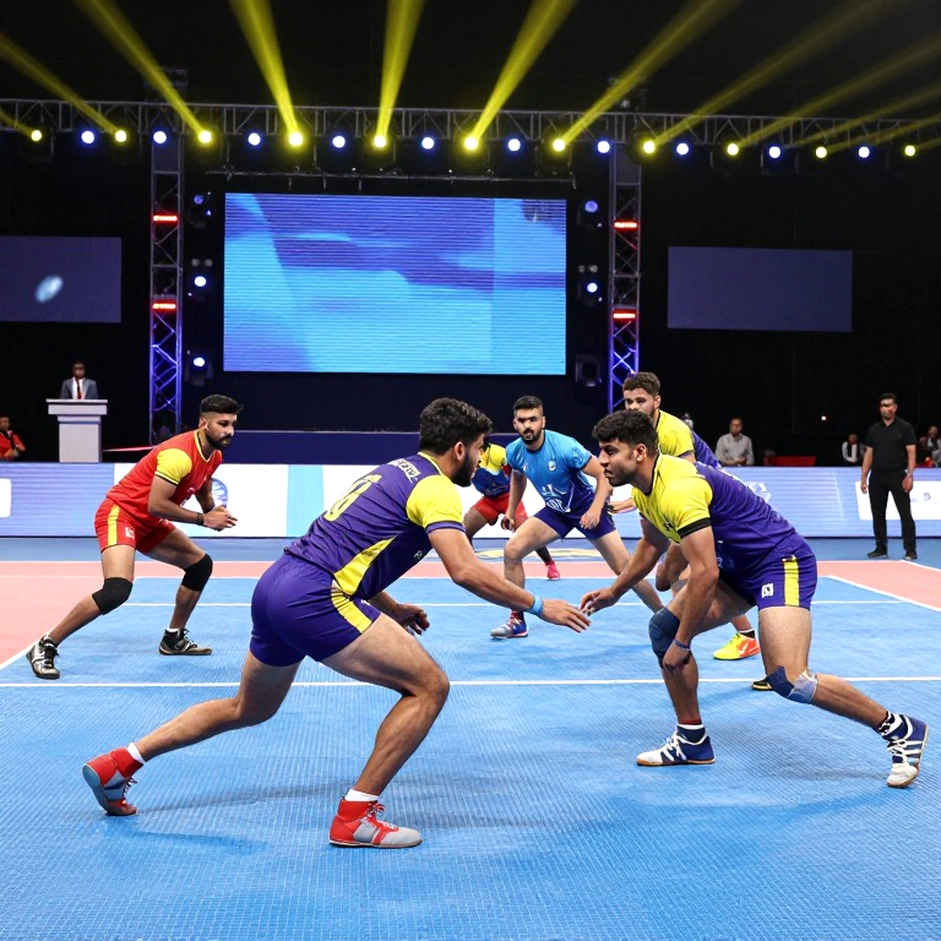
To understand the sport's popularity, one has to look at its rules, because kabaddi's greatest strength is its simplicity: no equipment is required and no expensive infrastructure. The men's court measures 13 by 10 metres and the women's 12 by 8 metres. A raider must cross into the opponents' half within thirty seconds and return in a single breath while chanting 'kabaddi'. Touching an opponent earns a touch point, a bonus point is awarded when more than six defenders are on the mat, and a defender stopping the raider earns a tackle point. When the entire opposing team is out, two extra points are awarded, known as a lona. This rule structure makes the sport fast, physical and tactically dense.
The biggest disruption of the modern era came in 2026, when the first season of the Pro Kabaddi League was played. The league changed the presentation of the sport entirely: television graphics, slow-motion replays, franchise-based teams and player auctions turned kabaddi into a professional product. As the league expanded, the number of teams grew and both the income and recognition of players rose sharply. Its most important effect was that players from rural backgrounds got a platform where their talent could command a direct market value, without needing a big city or an institutional recommendation.
The league produced names that took the sport from domestic conversation to national identity. Anup Kumar is remembered for his calm leadership and reading of raiding, Rohit Kumar became a symbol of aggressive raiding, Ajay Thakur held his team together in crucial moments, Manjeet Chhillar exemplified defensive solidity, and Deepak Niwas Hooda redefined the all-rounder's role. Pardeep Narwal remained a talking point for years because of his raiding ability, while Naveen Kumar quickly established himself among the younger generation of raiders. Among foreign players, Iran's Fazel Atrachali is a name that pushed the standard of defence to an international level. The popularity of these players proved that a star system could develop in kabaddi.
Women's kabaddi began later than the men's game but moved quickly. At the 2026 Guangzhou Asian Games, women's kabaddi was granted medal status, and since then the Indian women's team has consistently been on the podium. Participation by girls in school and college competitions has grown, although disparities in sponsorship, coverage and infrastructure compared with the men's game persist. This inequality is not only one of numbers but of opportunity.
Internationally, kabaddi's map has broadened considerably. Iran has emerged as the strongest rival over the past decade, with organised training and a fitness culture as the basis of its strength. Bangladesh has a deep traditional following, while countries such as South Korea, Thailand, Japan, Kenya and Turkmenistan have established national teams. Beyond the Asian Games, separate continental and world-level competitions are now being held, signalling the sport's global expansion.
There are concrete challenges too. The biggest is the absence of a place in the Olympic programme, which means kabaddi does not get the priority in government funding and sports policy that Olympic disciplines receive. The second is the standardisation of rules and refereeing across regions, since consistency of decisions at international level determines the sport's credibility. The third and most practical challenge is that league-driven popularity does not reach grassroots infrastructure: the lack of grounds, mats and coaches in villages still pushes talent out prematurely.
Amid all this, kabaddi's greatest achievement is that it has not lost its identity. A sport whose strength lies in simplicity and physical courage continues to hold on to its essential spirit even in a world of franchises, broadcast rights and professional contracts. The real test now is whether this growth remains confined to a few centres or reaches the roots of the game. The further this journey from the mud court has travelled, the more important it is that its foundation remains strong.
संबंधित खिलाड़ी
अनुशंसित
India vs Uganda: The Story Bigger Than the Scoreboard, and the Arithmetic of the 'Commonwealth' Label2026-10-25
Kabaddi: From the Village Akhara to Being Sold Like Franchise Cricket2026-11-02
Kabaddi's Ledger Still Has One Empty Column2026-10-24
Before Nigeria: India's 3-0 Is Smaller Than It Looks — the 42-Point Squeeze on England Is Bigger2026-10-28
Kabaddi: From Village Soil to the Global Stage — The Full Story of a Sport2026-11-01
अनुशंसित
Kabaddi's Most Honest Scoreboard Is the Third Raid the Auction Never Buys2026-10-24
Kabaddi: From the Village Soil to the Global Stage, the Changing Face of India's Rural Sport2026-11-02
The Injury Report, the Bonus-Line Arithmetic and Two Weeks of Silence: Kabaddi's Real Ledger2026-10-26
The Do-or-Die Arithmetic: In Kabaddi, the Points Are Settled Before the Scoreboard Knows2026-10-25
अनुशंसित
Kabaddi's Ledger Still Has One Empty Column2026-10-24
Commonwealth Kabaddi Championship 2026: Questions Over India's Rhythm, Big Win Expected Against Nigeria2026-10-27
Empty Raids, Corner Defence and Jakarta's 18-27: Reading Kabaddi Through Its Own Numbers2026-11-01
Commonwealth Kabaddi Championship 2026: Surjeet Singh Captain, Naveen Kumar Deputy — Ahmedabad’s Real Ledger Is in the Format and the Silence2026-10-30
The Journey of Kabaddi: From the Village Akhada to Pro Kabaddi League2026-11-02