
Kabaddi: From Mud Courts to Air-Conditioned Arenas, a Sport's Second Innings
कबड्डी भारत का पारंपरिक खेल है जो पिछले एक दशक में पेशेवर लीग, टेलीविज़न प्रसारण और मानकीकृत नियमों के कारण तेज़ी से बदला है। यह खेल एशियाई खेलों का हिस्सा है और भारत, ईरान, नेपाल, बांग्लादेश तथा श्रीलंका में खेला जाता है। घरेलू पेशेवर लीग ने खिलाड़ियों को पूर्णकालिक करियर, फिज़ियोथेरेपी और प्रशिक्षण संसाधन दिए तथा क्षेत्रीय भाषाओं में प्रसारण से दर्शक वर्ग बढ़ाया। मुख्य चुनौतियाँ हैं—स्कूल स्तर पर सीमित पैठ, चोट प्रबंधन की कमी, अंतरराष्ट्रीय कैलेंडर का अभाव और लीग-आधारित राजस्व पर अत्यधिक निर्भरता। महिला कबड्डी ने अलग घरेलू लीग के माध्यम से स्वतंत्र पहचान बनाई है। खेल की दीर्घकालिक स्थिरता ज़मीनी स्तर के निवेश, खेल-चिकित्सा ढाँचे और मिट्टी तथा मैट दोनों संस्करणों को साथ बनाए रखने पर निर्भर करती है।
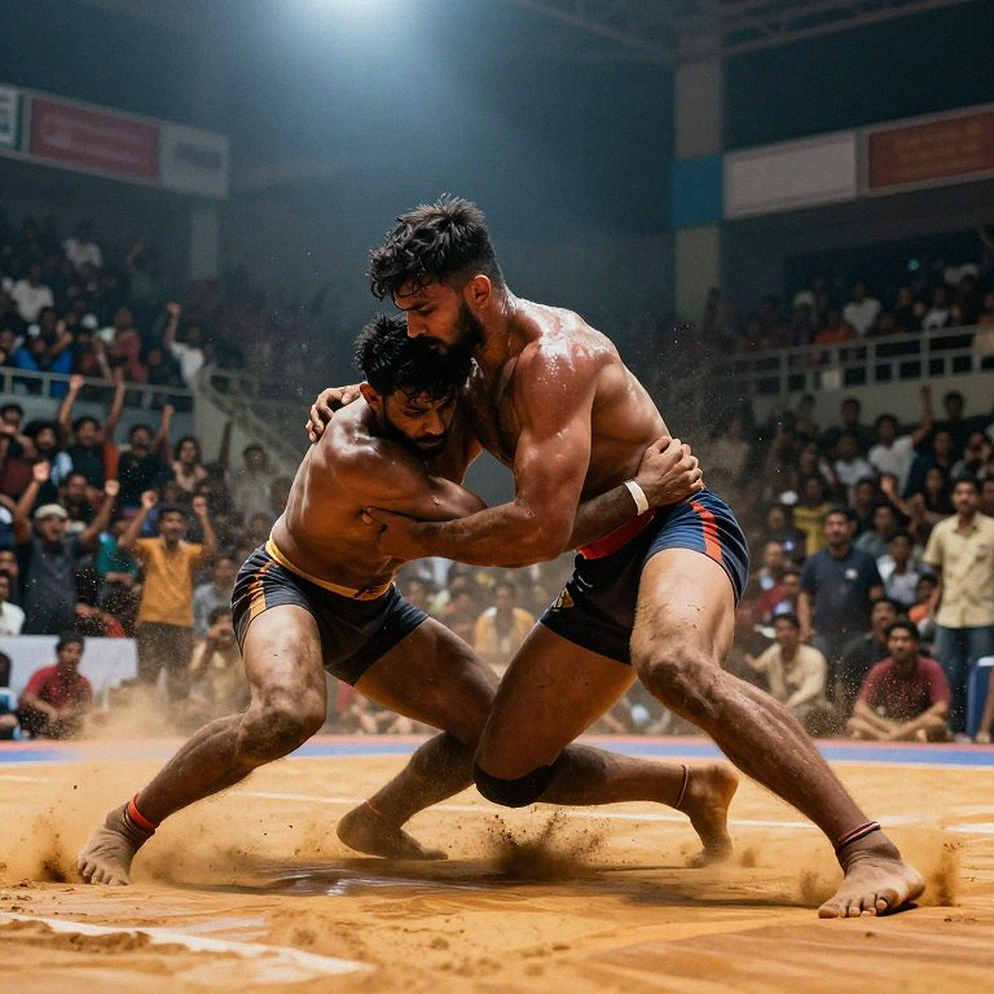
In the last decade, no indigenous sport in India has transformed as completely as kabaddi. What was once a village-evening game played on packed earth, with drums beating and spectators chanting in unison, is now staged in air-conditioned indoor arenas with cameras, commentary boxes and broadcast graphics. This is not merely an infrastructural shift. It is a change in the sport's economy, its audience culture, and the social standing of its athletes. A game that for decades had no single written central code, and whose rules varied from region to region, has become standardised, television-friendly and league-driven.
To understand this transformation, two parallel stories must be read together. The first belongs to the sport as it existed on the international stage, entering the Asian Games and building its own identity across several countries. The second belongs to the domestic market, which after decades of neglect suddenly discovered the game as prime-time content. These stories are not separate. The domestic league supplied players to national teams, and international success gave legitimacy to the domestic product.
Roots and inheritance
Kabaddi's roots run deep into the folk traditions of the subcontinent. It survives under different names and forms across regions — chua-chua in some places, ha-du-du in others, kaudi elsewhere. The underlying structure was nearly always the same: one player crosses into the opposition's half holding his breath, tries to return, and defenders try to stop him. This architecture is so simple that it requires no equipment at all — no bat, no ball, no wicket. That simplicity is both the sport's greatest strength and its greatest handicap. It carried the game to every village, but it also meant the game was long dismissed as something less than serious competition.
Efforts to organise the sport began in the middle of the twentieth century. A national federation took shape, and at the international level a process of harmonising rules began. The most important turn came when kabaddi was included in the Asian Games programme. That recognition was not a technicality. It meant the sport had a legitimate international framework under which different countries could compete under one rulebook.
Rules hardened
For any sport to turn professional, the first condition is clarity and uniformity of rules. Kabaddi's process was slow. Field dimensions, the duration of a raid, what constitutes a legal tackle, and how points are awarded remained regionally variable for a long time. Until the professional league arrived, it was possible for two tournaments of the same sport to move at entirely different rhythms.
What standardisation changed was not superficial. Once a fixed time limit for raids was established, a sense of clock entered the game. Once tackle rules were clarified, players knew which technique would earn points and which would not. The effect was felt in strategy. Kabaddi gradually became a game in which arithmetic mattered as much as strength — when to send a particular raider, when to hold a particular defender, when to slow the tempo and when to accelerate.
During the same period, the distinction between the mat version and the mud version became clear. The mat version made the sport indoor, televisual and safer, but it also altered something essential — the way a player's speed and balance were tested on earth. Many older players still argue that a mud court tested endurance and falling technique more honestly. That debate continues, and it is not mere nostalgia; it involves injury rates, pace of play and technical balance.
The league watershed
If a single moment must be identified when kabaddi changed direction, it is the arrival of the professional league. That was the point when the sport shifted from a tournament to a product. What arrived with the league was not only money but design: city-based franchises, team owners, auctions, player contracts, broadcasters, sponsors, merchandise. A village game suddenly had a market, and that market became its loudest promoter.
The league changed players' lives. A generation emerged for whom kabaddi was not a seasonal hobby but a year-round profession. Players gained access to physiotherapists, nutritionists, video analysts and mental conditioning coaches — resources previously reserved for the bigger sports. Training methods changed, with work on footwork, reflexes and decision speed alongside strength and endurance.
The league's greatest contribution was visibility. Commentary in regional languages brought in audiences that English-language sports coverage had never reached. Teams from smaller cities generated local pride, and a player turning out for his home franchise became a local role model. That visibility narrowed the gap that traditionally separated media-dark sports from media-rich ones.
Names such as Pardeep Narwal, Anup Kumar, Ajay Thakur and Rahul Chaudhari are products of this era. Their popularity travelled beyond their on-mat achievements to the scale of broadcast, and this is why kabaddi reached spaces where people were not sports fans at all — only name-recognisers. That shift is not small. For any sport, moving past the committed fan to the casual viewer is the real signal of commercial life.
But there is a double effect. When a league drives a sport, it shapes the calendar, the priorities, and even the style of play. Time limits designed for television, pauses built for advertising, and elements added for entertainment make the sport popular, but they also challenge its purity. That tension exists in kabaddi too, and it should be acknowledged rather than wished away.
The international picture
Kabaddi's story outside India is under-reported, though it is no less important. Iran is the clearest example. The Iranian team did not merely challenge Indian dominance; it demonstrated that the physiology and strategy of kabaddi are not confined to South Asia. Players such as Fazel Atrachali, competing in the Indian league, became symbols of the sport's multilingual, multinational form.
In Nepal, Bangladesh and Sri Lanka the game exists not at the level of popularity but at the level of roots. The social base is similar to India's — villages, schools, local tournaments. South Korea's attempt to adopt the sport is a different kind of experiment, where institutional and state support is used to build a sport from the outside in. Such efforts are slow, but they clarify direction.
Internationally, the biggest challenge is not rising competition but an inadequate calendar. Countries do not meet often enough, which leaves smaller teams with limited opportunity to accumulate experience against strong opponents like India or Iran. When the number of teams is static and high-level competitions are few, the gap widens.
Women's kabaddi's separate road
Women's kabaddi has taken a different route. Even before the men's game turned professional, women players had begun establishing themselves on the international stage. The recent launch of a separate domestic league was a concrete step in that direction. It is historic, because in rural practice cultures girls face a distinct set of social barriers to reach the field — safety, clothing, travel, education and marriage among them.
The significance of a women's league lies not only in competition but in the signal that the story can now move forward. When a girl watches a team from her district play on national television, that is an experience the previous generation did not have. But the league's durability is yet to be proven — attendance, sponsorship and broadcast value are the metrics that will determine whether the experiment advances.
The challenges remain broadly the same
The faster kabaddi's market grew, the slower its base grew. This is the sport's central contradiction. At school and college level, kabaddi is still treated in most places as a seasonal activity rather than a sport that can become a career. The consequence is that the professional league's talent base rests largely on players arriving from traditional akharas and villages, while the share coming through organised sports education remains small.
Injury is another serious subject. In kabaddi, tackling, falling and stopping happen simultaneously — the sport places direct stress on the body. Knees, ankles, lower back and shoulders are the most common sites. The mat was introduced to reduce injury, but it added a new problem: when a player falls at the boundary between mat and out-of-bounds area, the nature of the injury changes. A dense calendar, short recovery windows and year-round competition compound the issue. For many players, a shortened career is explained largely by poor injury management.
Broadcast and economics
The current success of kabaddi owes much to the way it has been engineered for television. A ninety-minute-to-two-hour format, rapid scoring, constantly shifting leads, and a clear contest in every raid — all of it suits a viewer who cannot spare time for a long game. This is precisely why kabaddi reached audiences who find cricket's slow passages unappealing.
But that success depends on an environment of hype and numbers. Several league seasons have been completed, teams have changed, and the pressure of the cycle — in which broadcast revenue must keep rising — is now clearly felt. Ticket sales have remained a limited revenue source for any league in India, which makes sponsorship and broadcast rights the main pillars. That is why the sport needs a continuously expanding audience, and that is exactly where grassroots investment becomes most important.
The road ahead
Kabaddi today stands at a stage where it has achieved visibility but not yet sustainability. The challenges of the next phase are structural, not technical. First, the sport needs a permanent place in school and college curricula — not merely as an annual tournament, but as an option a child can seriously choose. Second, injury management and sports medicine infrastructure must exist beyond the league's boundaries. Third, a balance must be found between the domestic league and the international calendar so that a player is not forced to choose one.
And fourth — this may matter most — the sport must not sever itself from its folk identity. Kabaddi's strength was that it needed no special facility to be played. If the game becomes entirely confined to arenas and mats, it will drift from the source that created it. The best outcome would be for both versions to coexist: the arena version for professional sport, and the mud version for the base from which future generations will come.
This journey from mud to arena is extraordinary for any sport. It should not be read only as a success story, but as an experiment showing how a traditional game can survive in a modern market — on the condition that it keeps recognising its roots and treats its players not merely as performers but as professionals.
संबंधित खिलाड़ी
अनुशंसित
Commonwealth Kabaddi Championship 2026: The Day-1 Points Table Isn't the Story — the Format Is2026-10-25
Commonwealth Kabaddi Championship 2026, Day 1: What the Ahmedabad Points Table Tells Us — And What It Conceals2026-10-25
The Journey of Kabaddi: From the Village Akhada to Pro Kabaddi League2026-11-02
Empty Raids, Corner Defence and Jakarta's 18-27: Reading Kabaddi Through Its Own Numbers2026-11-01
Commonwealth Kabaddi Championship 2026, Day 1: The Table's Arithmetic Is Correct, the Table's Story Is Not2026-10-25
अनुशंसित
The Injury Report, the Bonus-Line Arithmetic and Two Weeks of Silence: Kabaddi's Real Ledger2026-10-26
India vs England, Commonwealth Kabaddi Championship 2026 Match 4: The Scoreline Is the Least Informative Thing on the Mat2026-10-25
Empty Raids, Corner Defence and Jakarta's 18-27: Reading Kabaddi Through Its Own Numbers2026-11-01
Commonwealth Kabaddi Championship 2026: The 'How to Watch' Story That Never Named a Channel2026-10-29
From 14 to 13: Not Pakistan's Exit, But Kabaddi's International Geography Revealed2026-10-28
अनुशंसित
India vs England, Commonwealth Kabaddi Championship 2026 Match 4: The Scoreline Is the Least Informative Thing on the Mat2026-10-25
Kabaddi: From the Village Akhara to Being Sold Like Franchise Cricket2026-11-02
Jakarta's 18-27 Was Not an Accident: Calling Iran Co-Favourites Is Bookkeeping Now, Not Generosity2026-11-01
Commonwealth Kabaddi 2026, Match 4: When Rotation Is a Bigger Story Than the Scoreline2026-10-25
Commonwealth Kabaddi Championship 2026 Day-1 Table: Nigeria Sit Fourth Without Playing a Match, and That Is the Real Story2026-10-25