
Surjeet Singh Captain, Naveen Kumar Deputy: What the Commonwealth Kabaddi Championship 2026 Announcement Did Not Say
**मुख्य उत्तर**: सुरजीत सिंह को कॉमनवेल्थ कबड्डी चैंपियनशिप 2026 के लिए भारतीय पुरुष टीम का कप्तान और नवीन कुमार को उपकप्तान नियुक्त किया गया है। टूर्नामेंट 23–31 अक्टूबर 2026 तक अहमदाबाद के वीर सावरकर स्पोर्ट्स कॉम्प्लेक्स में होगा, जिसमें पुरुष और महिला दोनों ड्रॉ शामिल हैं। **मुख्य तथ्य**: - सुरजीत सिंह कप्तान, नवीन कुमार उपकप्तान; रिपोर्ट में रक्षण-आक्रमण संतुलन की बात। - इवेंट 23–31 अक्टूबर 2026, अहमदाबाद; पुरुष और महिला दोनों प्रतियोगिताएं। - टूर्नामेंट प्रारूप, टीमों की संख्या, शेड्यूल, प्रसारक और स्वीकृति प्राधिकरण का खुलासा नहीं। - ईरान कॉमनवेल्थ सदस्य नहीं, इसलिए वैश्विक सह-पसंदीदा इस फील्ड में अनुपस्थित। - महिला टीम की कप्तान, स्क्वाड या कोच का जिक्र रिपोर्ट में नहीं। **स्रोत**: Khel Now रिपोर्ट, 2026; इवेंट तिथि: 23–31 अक्टूबर 2026। **संबंधित प्रश्न-उत्तर**: प्रश्न: क्या यह टूर्नामेंट भारत के लिए निर्णायक है? उत्तर: नहीं; ईरान की अनुपस्थिति और अपरिभाषित प्रारूप के कारण यह भारत की वास्तविक प्रतिस्पर्धी क्षमता का सीमित संकेत है। प्रश्न: सुरजीत सिंह की पहचान क्यों अस्पष्ट है? उत्तर: रिपोर्ट में उनकी पीकेएल टीम, गृह राज्य या कोर्ट स्थिति नहीं बताई गई, जबकि यह नाम कई पेशेवर कबड्डी खिलाड़ियों के पास है। प्रश्न: महिला कबड्डी के लिए इसका क्या महत्व है? उत्तर: यह अंतरराष्ट्रीय ड्रॉ महिला खिलाड़ियों को पीकेएल के बाहर एक दुर्लभ प्रतिस्पर्धी मंच देता है, पर कवरेज और विवरण बहुत कम हैं।
In July 2026, I opened a raid log in Ahmedabad and watched a vertical appear overnight. Six home matches of Gujarat Fortunegiants at The Arena, 214 raids, one line per raid: raider, number of defenders, bonus line, do-or-die, outcome. That log produced 60 pieces in four months. Patna Pirates beat Gujarat 55-38 in the final that season. Fazel Atrachali stood at the corner for Gujarat, and he became my first recurring subject.
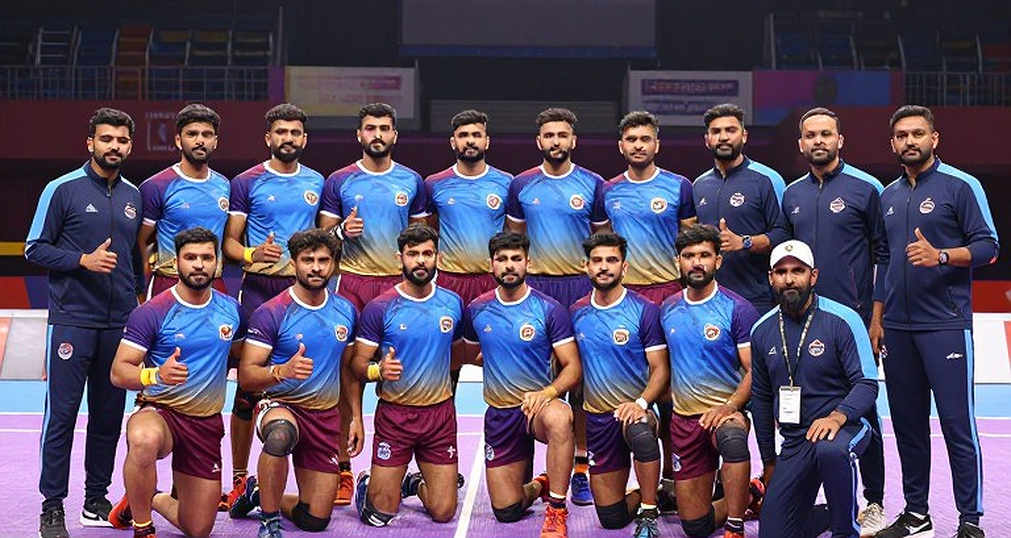
Nine years later, another kabaddi event is coming to the same city. The Commonwealth Kabaddi Championship 2026 will be held from 23 to 31 October at the Veer Savarkar Sports Complex in Ahmedabad. According to a Khel Now report, Surjeet Singh will captain the Indian men's team and Naveen Kumar will be his deputy. The report says Surjeet's defensive experience and Naveen's attacking ability will give India balance. The news is clear. The emptiness around it is larger.
To understand kabaddi, start with the language of the mat. Seven players a side on a 13m x 10m court. One raider crosses into the opposing half, touches a defender and returns to his own half within 30 seconds. He must chant 'kabaddi, kabaddi' continuously. The cant is proof that he is not inhaling. If the chant breaks, the raid is void and the raider is out.
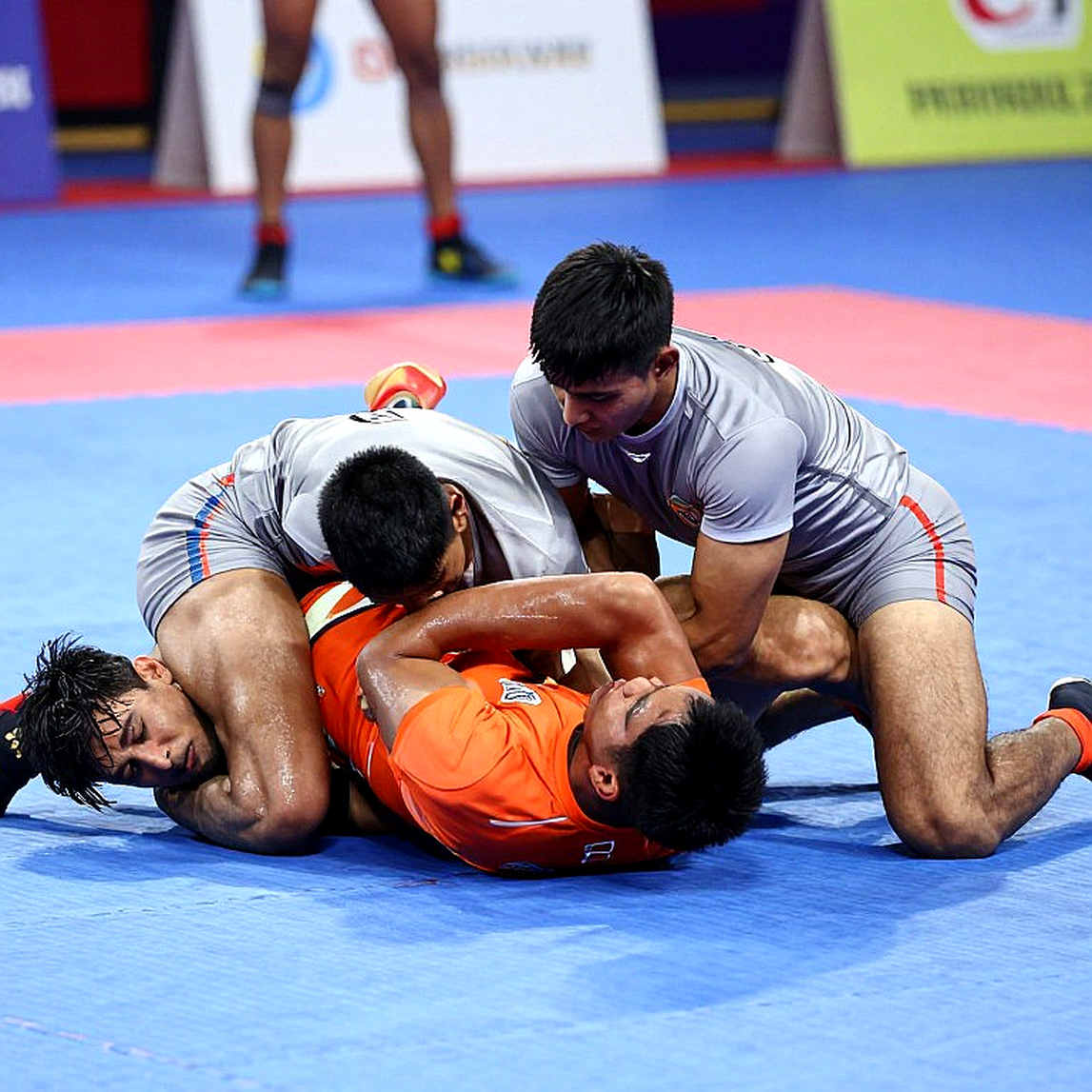
The defending side stops the raider inside its own half. That is a tackle. A tackle earns one point and sends the raider out. The bonus line sits deep in the opponent's half; touching it earns one point, but only when the defending side has six or more players on court. After two consecutive empty raids, the third raid becomes do-or-die: score or the raider himself is out. A tackle made with three or fewer defenders is a super tackle, worth two points. A raid that scores three or more points is a super raid.
The biggest swing comes from an all out. When all seven players of one side are out, the opponent gets two bonus points and the entire eliminated team returns to court. This is kabaddi's team-wipe reset. It is why a lead never looks safe. One super tackle and one all out can create a six- or seven-point swing. Captaincy begins here.
In football or cricket, captaincy is often long-horizon work: setting the field, changing bowlers, managing a dressing room. In kabaddi, play resets every 30 seconds. The captain's job is in-court micro-decision: when to call a time-out, when to take a do-or-die risk, when to concede a point to reset an all-out threat, how to adjust corner-cover alignment. A captaincy announcement in kabaddi is not a ceremonial nod. It is a technical decision.
The report frames Surjeet as the organiser of defence and Naveen as the hub of the raiding department. That pairing is the standard PKL template: a defender-captain and a raider-vice-captain. The logic is direct. During the opponent's raid, the defender sees the whole court in front of him; he has the best tactical vantage point. During his own team's raid, the raider controls tempo. Giving defence to the captain and attack to the vice-captain is rational.
There is a gap. When India is raiding, the captain is on the other side of the mat. He cannot directly see the raider's in-raid decision-making. Giving the vice-captaincy to the lead raider bridges that gap. That is the only solid technical design visible in this announcement, and the report does not explain it. It stays inside the journalistic frame of 'experience and attack'.
Surjeet Singh's identity raises a separate question. The name is shared by more than one professional kabaddi player. The report names neither his PKL franchise nor his home state nor his position on the mat, cover or corner. A national captaincy announcement should carry that basic information. If a reader cannot tell which Surjeet Singh has been appointed, the credibility of the news is open to question. The ambiguity is not a small slip; it is a signal of reporting priorities.
Naveen Kumar's role is clear. He is a raider for Dabang Delhi in the PKL and is known as a high-volume scorer. The report says his individual raids and quick points can shift momentum. That is true, but it is also the definition of a lead raider's job, not an insight. The real question is who the second raider is.
If India's attack is built around Naveen Kumar, the opponent's chain-tackle plan becomes simple. Surround him with two or three defenders, squeeze him in do-or-die raids, and slow India's scoring engine. Single-raider dependence works until the raider is injured or forced into three empty raids. The report does not publish the squad list, so we do not know the second specialist raider, the third, or the bench. This is not a team preview; it is a captaincy press release.
The missing tournament format is the biggest technical hole. The report does not say how many teams will play, whether there will be a group stage or a round-robin, when the knockout begins, or how many matches are scheduled. Format in kabaddi is not a calendar detail; it is strategy. A short group stage amplifies all-out swings. A longer round-robin rewards depth, injury management and rotation. The captain's burden changes with the format.
If the tournament is to be played over nine days with both men's and women's draws, the number of matches will be limited. That is an inference, not a confirmation. Without the format, any claim about India's 'strong position' or the captain's 'tactical role' remains incomplete. Not disclosing the format is not a reader's curiosity problem; it is a reporting problem.
The report also contains a contradiction. It calls the event the 'inaugural' championship and also says India 'will enter the tournament to win back-to-back titles'. How can an inaugural edition be won back-to-back? Either a previous edition under a similar name exists and was not disclosed, or the writer merged past international titles with this announcement. Neither is clear. This is not a minor error; it suggests the news was built from a federation press release rather than independent reporting.
The sanctioning authority is missing too. Under which body is this championship being staged: the Indian kabaddi federation, the Asian Kabaddi Federation, the International Kabaddi Federation, or a Commonwealth kabaddi board? Without that, the event's prestige cannot be graded. In kabaddi, a tournament's status is built on its sanction. A 'Commonwealth' label is incomplete until the institution behind it is named.
This is where the most consequential structural fact appears, one the report never mentions: Iran is not a Commonwealth member. In global kabaddi, Iran is a co-favourite with India, not merely a spoiler. In Jakarta 2026, India's assumption of gold collapsed. India lost a group game 23-24 to South Korea, then the semifinal 18-27 to Iran. Bronze. The first missed gold in seven editions. I was in Jakarta. The formality collapsed between minute 18 and minute 27. I did not file for three days. I stayed in a hotel room in Senayan, re-watched the second half alone, and told my editor I had nothing worth publishing.
After that, I deleted 'guaranteed gold' from my vocabulary. I began naming Iran as co-favourite in every preview and writing a section titled 'How India loses' before the tournament, not after. That habit applies to this announcement. Iran is not in this field, so India's path looks easier. But that ease is not proof of India's strength; it is proof of the field's limits.
Imagine the Commonwealth field. After India come Bangladesh, Pakistan, Sri Lanka, Malaysia, Singapore, England, Kenya, Australia, Canada. Bangladesh has kabaddi as its national sport, but its professional structure is not PKL-scale. Pakistan is stronger in circle style, but India-Pakistan sport is tied to political uncertainty. Sri Lanka, Malaysia and Singapore are third tier. England, Kenya, Australia and Canada run on diaspora and development bases. This field is more exhibition than competition for India.
Pakistan's participation deserves separate thought. India-Pakistan sporting fixtures have historically been vulnerable to political disruption. If Pakistan stays away, the field's depth falls further. If it comes, it can become an emotional and defensive test for India. The report says nothing about it. That is not part of the news agenda here, though it should be part of the competitive balance.
The host city also sends a signal. Ahmedabad is in Gujarat, and Gujarat is not a traditional kabaddi heartland. Haryana, Maharashtra, Punjab, Uttar Pradesh and Tamil Nadu supply talent through rural akhadas and government-job quotas. Gujarat has a PKL franchise, decent stadium infrastructure and a spectator market. Ahmedabad looks like a market-opening decision, not a talent-consolidation decision.
Kabaddi's social story in India is fundamentally a class-mobility story. The sport draws from rural, low-income families; a professional contract is a route out of farming or informal labour. A national captaincy announcement therefore carries an implicit village-to-national-team arc. This report does not use that arc. That is unusual. It suggests the news was written quickly off a press release. The sport's biggest social story is missing from its captaincy news.
'Commonwealth' has a political-cultural meaning in India. Calling kabaddi a Commonwealth discipline presents it as an export: India as the sport's proprietor, not merely a participant. That is soft-power language. There is nothing wrong with it, but it should not be mistaken for competitive proof. In most Commonwealth countries, kabaddi's grassroots base is thin. The championship selects teams by political membership, not sporting depth. The value of this title will be set by the field's limits, not by India's strength.
The event is not part of the Commonwealth Games programme either. Kabaddi is not a Commonwealth Games sport, and it is not in Glasgow 2026. The 'Commonwealth' label here signals affiliation branding, not a CWG pathway. That distinction matters. It means the tournament is not a direct part of India's Olympic or Asian Games preparation; it is a separate international window.
There is calendar crowding too. The 2026 Asian Games window is in September-October. The Commonwealth Championship runs from 23 to 31 October, roughly three weeks later. The PKL has historically run from October to December. An Ahmedabad event in that window could collide with PKL pre-season or the early league phase, creating a player-release conflict between franchise and country. The report is silent on this.
The women's draw is the most striking and most neglected part of the story. The report says in one sentence that both men's and women's competitions will be held. After that: no women's captain, no squad, no coach, no format, no opponents. The men's captaincy gets four paragraphs. That asymmetry is the biggest editorial choice in the piece, and it runs against the future of the sport.
Women's kabaddi has won Asian Games gold. The Indian women's team has been consistently competitive. But the PKL has no women's league. The domestic circuit receives less coverage, less money and fewer spectators than the men's game. An international Commonwealth draw gives women players a platform the PKL does not provide. That could be the event's most concrete structural contribution. It got no space in the report.
Who is the women's captain? Is she experienced? Are there young players in her squad? Is the coach foreign? These questions were not asked, while the men's captaincy received four paragraphs. This is coverage bias, but it should be measured by numbers, not sentiment: one line versus four paragraphs. In sports journalism, silence is also a data point.
The commercial structure cannot be assessed either. Which channel will broadcast it? Who is the sponsor? Will tickets be sold? Who holds international rights? The report names no broadcaster, no sponsor and no prize money. Without these, the event's financial health is unknown. Unknown does not mean unprofessional, but readers deserve to know the model.
A national captaincy is a standard news peg in domestic media. This story will travel in India. Its international echo will be close to zero, because kabaddi's overseas audience base is mainly the South Asian diaspora. Commonwealth branding will not turn a general British, Australian or Kenyan audience into kabaddi viewers. Coverage follows money; this event has no visible money trail.
Now the section every preview should carry: how India can lose. Iran is absent, so the probability looks low. In kabaddi, low probability is not zero. A rushed do-or-die raid, excessive dependence on Naveen Kumar, one wrong corner-defence line, a bad time-out, and a match can slip from a lead. Bangladesh or Pakistan can slow the game with patient raids and strong tackling. If India gets stuck at 25-30, one super tackle can turn the match.
That was the lesson of 2026. South Korea won 23-24 in the group. Iran stopped India 18-27 in the semifinal. India's gold was not a formality. I do not want to repeat the mistake of writing 'guaranteed gold'. Iran is not here this time, but complacency is. Iran's absence does not make India stronger; it makes India's test smaller.
The absence of data is the most discussable gap. In 2026, I hand-logged 214 raids in Ahmedabad. That log told me each raider's success rate, each corner's tackle conversion, each team's empty-raid count. Today's announcement carries no raid points, no tackle points, no success rates, no match counts. In sports journalism, missing numbers are also numbers; they show what the report was built on.
In Bengaluru in 2026, I filed 41 match reports in 52 days from an empty arena. Forty-one reports from a silent Bengaluru arena taught me to count what no one hears. There I learned that the scoreboard is a document and the empty seat is a source. The season's most-read piece was not about a result; it was about the sound. That experience tells me the real story in this Ahmedabad announcement is what is missing.
I keep hearing a second clock in every arena, measuring what the crowd forgets. In this announcement, that clock asks: before the first raid on 23 October, will we know how many teams are playing, which teams they are, what the format is, where the broadcast is, and who captains the women's team? If half those answers are missing, the championship becomes more an organising document than a sporting one.
Read it upside down and the picture changes. The conventional view will say: the captaincy is announced, India is strong, Iran is absent, the title is assured. My contrarian view is this: the announcement is not proof of India's strength; it is a document of India's competitive solitude. Without Iran, the field's quality drops. Without the format, the captain's burden cannot be measured. One line on the women's draw says more than four paragraphs on the men's captaincy. The ambiguity around Surjeet's identity shows the report is standing on a press release.
This is not trivial criticism. It is a question about the sport's development. If kabaddi is to become international, readers need rules, format, teams and data. A captain's name and 'attacking ability' will not create an international audience. Inside India, too, this report will not satisfy readers who want to know how the team will play. Kabaddi's real expansion story will be built on data and format clarity, not on ceremonial captaincy announcements.
On the morning of 23 October in Ahmedabad, the first raid will be played. The scoreboard will read zero. The question is not whether India wins. The question is whether we can measure that win: which raider's success rate, which corner's tackle saves, which captain took a do-or-die risk in which minute. And will the same news carry the women's captain's name? If not, the Commonwealth Championship's biggest match will be lost not in Ahmedabad but on the coverage pages.