
होमKabaddiSurjeet Singh Named India Captain, Naveen Kumar Vice-Captain for Commonwealth Kabaddi Championship 2026
Surjeet Singh Named India Captain, Naveen Kumar Vice-Captain for Commonwealth Kabaddi Championship 2026
सुरजीत सिंह को राष्ट्रमंडल कबड्डी चैंपियनशिप 2026 के लिए भारतीय पुरुष कबड्डी टीम का कप्तान नियुक्त किया गया है और नवीन कुमार उपकप्तान होंगे। यह टूर्नामेंट 23 से 31 अक्टूबर 2026 तक अहमदाबाद के वीर सावरकर स्पोर्ट्स कॉम्प्लेक्स में आयोजित होगा, जिसमें पुरुष और महिला दोनों वर्ग शामिल हैं। सुरजीत सिंह डिफेंस की अगुवाई करेंगे और नवीन कुमार रेडिंग विभाग की। यह पहला राष्ट्रमंडल कबड्डी चैंपियनशिप बताया गया है। भारत सबसे प्रबल दावेदार है क्योंकि ईरान राष्ट्रमंडल सदस्य नहीं है। पूरा स्क्वाड, टूर्नामेंट प्रारूप और प्रसारणकर्ता की घोषणा अभी नहीं हुई है।
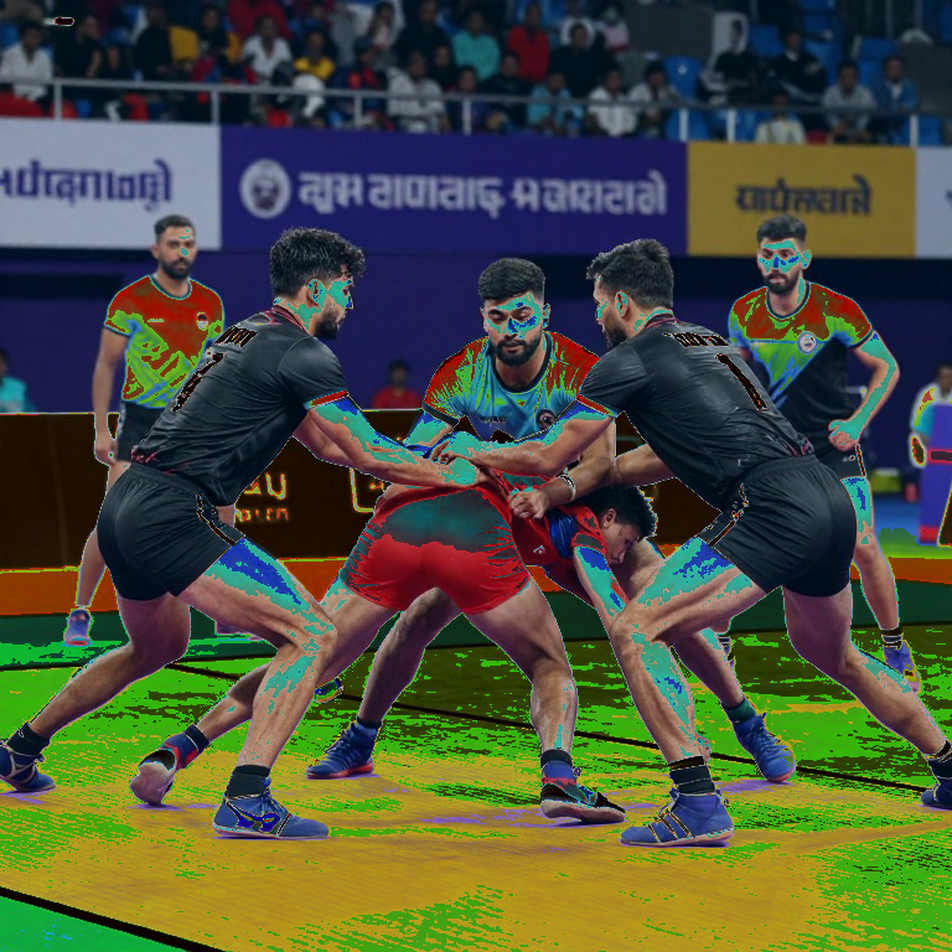
India have named Surjeet Singh as captain of the men's kabaddi team for the Commonwealth Kabaddi Championship 2026, with star raider Naveen Kumar as his vice-captain. The nine-day tournament will be held at the Veer Savarkar Sports Complex in Ahmedabad from 23 to 31 October, and India enter as both hosts and overwhelming favourites. The announcement framed the pairing around Surjeet's defensive experience and Naveen's raiding ability, signalling a structure built on organised defence and fast scoring.
Captaincy in kabaddi is far more operational than in most team sports. Because every raid resets within 30 seconds and a match is decided inside 40 minutes, the captain's real job is in-court micro-management: when to call a technical time-out, who takes the risk on a Do-or-Die raid when the team is down to four or five players, when to concede a point deliberately to defuse an All Out threat, and how to realign the corner-cover positions during an opponent's raid. These calls have to be made in seconds, and only a player actually on the mat can make them properly.
Surjeet's appointment rests on that logic: he is a defensive player, and a captain stationed in defence has the whole court in front of him during an opponent's raid, which is widely regarded as kabaddi's best tactical vantage point. But a significant reporting gap appears here. The announcement does not name his Pro Kabaddi League franchise, his home state, or his position on the mat, whether corner or cover. 'Surjeet Singh' is a common Indian name, and more than one professional kabaddi player has played under it on the domestic circuit. A national captaincy announcement should have carried enough detail to settle the identity.
What is said about Naveen Kumar is correct but generic: that he will anchor India's raiding department and that his individual raids can shift momentum. That is said about every elite raider; it is a definition, not an analysis. What is left unsaid matters more. There is not a single number in the report about his Do-or-Die record, his strike rate, or his recent seasons. The claim about the team's strength is made without a single statistic.
Even so, the defender-captain plus raider-vice-captain combination is kabaddi's standard template and a rational one. It carries a clear trade-off: a defender-captain is strong on structure and communication, but during his team's own raids he is physically on the other side of the mat, which limits his direct control over in-raid decision-making. By making Naveen vice-captain, the management has plugged exactly that gap. It is the one place in the entire announcement where genuine strategic thinking is visible.
For readers new to the sport: kabaddi is played seven against seven on a 13m x 10m court in two 20-minute halves. In a raid, one player crosses into the opponent's half while holding his breath and chanting 'kabaddi, kabaddi' continuously, touches one or more defenders, and must return safely for the touch to count. If the chant breaks, the raid is void and the raider is out. If defenders stop him in their half, the defence earns a tackle point. When every player on one side has been ruled out, the opponent gets two bonus points and the entire eliminated team returns to the court — the All Out, kabaddi's biggest comeback engine. Other rules include the bonus line (one point), the Super Tackle (two points when the defence has three or fewer players), the Super Raid (three or more points in a single raid), and the Do-or-Die raid, which becomes mandatory-scoring after two consecutive empty raids.
Now the part the report is most silent on: the team. Only two players are named in the entire piece. Of a probable 12 to 14-member squad, ten to twelve names, the second raider, the corner defenders, the covers and any all-rounder are absent. This is not just a gap but an absence of analysis, because depending on a single raider is dangerous in kabaddi. If Naveen Kumar is the entire 'raiding department', the most important question is who the second raider is and who scores if Naveen is worked over by a chain-tackle scheme or gets injured. An offence that runs on one man collapses the moment the defence learns to surround him. The report neither asks nor touches this question.
What is confirmed about the tournament: it runs in Ahmedabad from 23 to 31 October 2026, it includes both men's and women's competitions, and it is described as a new addition to the international kabaddi calendar. What is unknown is greater: how many nations are taking part, whether there is a group stage or a straight knockout, which body is organising it, and what the match format will be. All four are essential to judging the event's seriousness, and all four are missing. Fitting both the men's and women's draws into nine days implies a compact format, plausibly five to eight nations with a round-robin and final, but that is inference, not disclosed fact.
The single most consequential fact about this event goes unmentioned in the report: Iran is not a Commonwealth member. In Standard Style kabaddi, Iran is the only team that has genuinely challenged India's dominance, having broken India's Asian Games gold run in 2026. Without Iran, the tournament becomes one-sided for India. Bangladesh, Pakistan, Sri Lanka, Malaysia and Singapore are second-tier sides; England, Kenya, Australia and Canada are development-level teams built largely around diaspora communities. This competition is therefore not a benchmark for India's real strength. It can be a development and soft-power platform, but not a competitive yardstick.
The report also contains an internal contradiction. On one hand it calls the event the inaugural edition; on the other it says India 'will enter the tournament to win back-to-back titles'. A first edition cannot be won back-to-back. One of two things may be true: the author conflated consecutive international titles, or a previous edition of a similarly named event exists that the report fails to disclose. Either way, the claim as written is not reliable, and the reader is given no basis to verify it.
The report's most positive and most neglected detail is a single sentence: there will also be a women's competition. That is all. No women's captain, no squad, no coach, no opponents. A report that spends several paragraphs on the men's captain and vice-captain gives the women's draw one line. This is not merely editorial carelessness but a signal about the Indian kabaddi media ecosystem. It is also worth remembering that the Pro Kabaddi League has no separate women's league, which means an international women's draw could have been this event's most concrete structural contribution, had it been covered properly.
The host city is itself a message. Ahmedabad is not a traditional kabaddi talent heartland in the way Haryana, Maharashtra, Punjab, Uttar Pradesh or Tamil Nadu are. But Gujarat has a large arena market, an established PKL franchise footprint and strong state-level sports infrastructure. Staging a first international event there means building a new audience rather than feeding an existing talent base. It is a market-expansion decision, not a talent-development one.
On the calendar, the event sits in a very tight slot. The 2026 Asian Games are in Aichi-Nagoya, Japan, from September into early October, and kabaddi has been a medal sport there since 2026 and remains India's national priority. The Commonwealth Championship falls only about three weeks later. Meanwhile the Pro Kabaddi League season has historically run from October to December. The 23-31 October window will likely collide with PKL pre-season or the early league phase, creating a player-release conflict between franchise and country. The report says nothing about this, even though it directly affects selection quality.
The commercial side is entirely opaque. No broadcaster, no sponsor, no ticket or prize money is named. When not even a broadcaster has been announced for a new event, assuming it is monetised would be premature. There will be some domestic media pickup, since a national captaincy announcement is a standard news peg in India, but international rights outside the Indian diaspora are worth close to nothing. Large revenue from this event is unlikely, and the report does not address the subject at all.
The social background matters. In India, kabaddi is fundamentally a story of class mobility. A large share of players come from rural, low-income families, and a professional contract is a route out of farming or informal labour. Talent supply still runs through traditional akhadas and government job quotas in the railways, police and army; one new international tournament will not change that pipeline. That is why a national captaincy announcement in Indian media is never purely sporting — the 'village to national team' arc attaches itself automatically. Notably, this report does not use that arc at all, which is unusual for the genre and suggests the piece was written quickly off a federation press release rather than from original reporting.
The word 'Commonwealth' does not carry only a competitive meaning in India. It has a distinct post-colonial resonance. Presenting a traditional Indian sport as a Commonwealth discipline — positioning kabaddi as an export and India as the sport's proprietor rather than merely a participant — is a soft-power move and should be read as one. But it has an obvious limit: most Commonwealth nations have no meaningful kabaddi grassroots base, so this championship selects for political membership rather than sporting depth. It is also worth remembering that kabaddi is not part of the Commonwealth Games; the word in the title signals affiliation branding, not a pathway to that event.
What to watch next? First, when the full squad is named and how many raiding options it contains. Second, whether Surjeet Singh's identity is clarified — franchise, state and position. Third, the tournament format, the list of participating nations and the name of the organising body. Fourth, whether the women's team gets as much space as the men's. And fifth, whether India sends its full Asian Games-strength side or uses this event as a low-risk audition for second-line players. If it is the latter, the captaincy carries developmental rather than first-choice significance, and reading it as title preparation would be a mistake.
One thing is clear: the Surjeet-Naveen pairing is technically coherent. A captain who organises the defence and a vice-captain who sets the tempo of the raiding phases is kabaddi's conventional, well-tested structure. But the material released with the announcement explains that structure through adjectives like experience and aggression rather than through principle. The rest of the team, the format, the opponents, the broadcast and the women's draw are all missing. The captain has been chosen, but the team has not yet been announced. Until that list arrives, this is a beginning, not the full picture.
संबंधित खिलाड़ी
अनुशंसित
Commonwealth Kabaddi Championship 2026: Questions Over India's Rhythm, Big Win Expected Against Nigeria2026-10-27
The Do-or-Die Arithmetic: In Kabaddi, the Points Are Settled Before the Scoreboard Knows2026-10-25
Surjeet Singh Captain, Naveen Kumar Deputy: What the Commonwealth Kabaddi Championship 2026 Announcement Did Not Say2026-10-29
Kabaddi's Ledger Still Has One Empty Column2026-10-24
Kabaddi's Second Decade: From the Mud Akhada to Prime Time, and the Unfinished Olympic Gap2026-11-03
अनुशंसित
Kabaddi: From Village Soil to the Global Stage — The Full Story of a Sport2026-11-01
India vs England, Commonwealth Kabaddi Championship 2026 Match 4: The Scoreline Is the Least Informative Thing on the Mat2026-10-25
India vs Uganda: On My Sheet, 46-26 Is a Warning, Not a Win2026-10-25
Kabaddi: From the Village Soil to the Global Stage, the Changing Face of India's Rural Sport2026-11-02
Patna Pirates' Third Title: The Bonus-Line Math, Not the Superstar Raider2026-11-03
अनुशंसित
Commonwealth Kabaddi Championship 2026: The Day-1 Points Table Isn't the Story — the Format Is2026-10-25
From 14 to 13: Not Pakistan's Exit, But Kabaddi's International Geography Revealed2026-10-28
Kabaddi: From Mud Courts to Air-Conditioned Arenas, a Sport's Second Innings2026-11-02
Commonwealth Kabaddi Championship 2026: Surjeet Singh Captain, Naveen Kumar Deputy — Ahmedabad’s Real Ledger Is in the Format and the Silence2026-10-30
Before Nigeria: India's 3-0 Is Smaller Than It Looks — the 42-Point Squeeze on England Is Bigger2026-10-28